
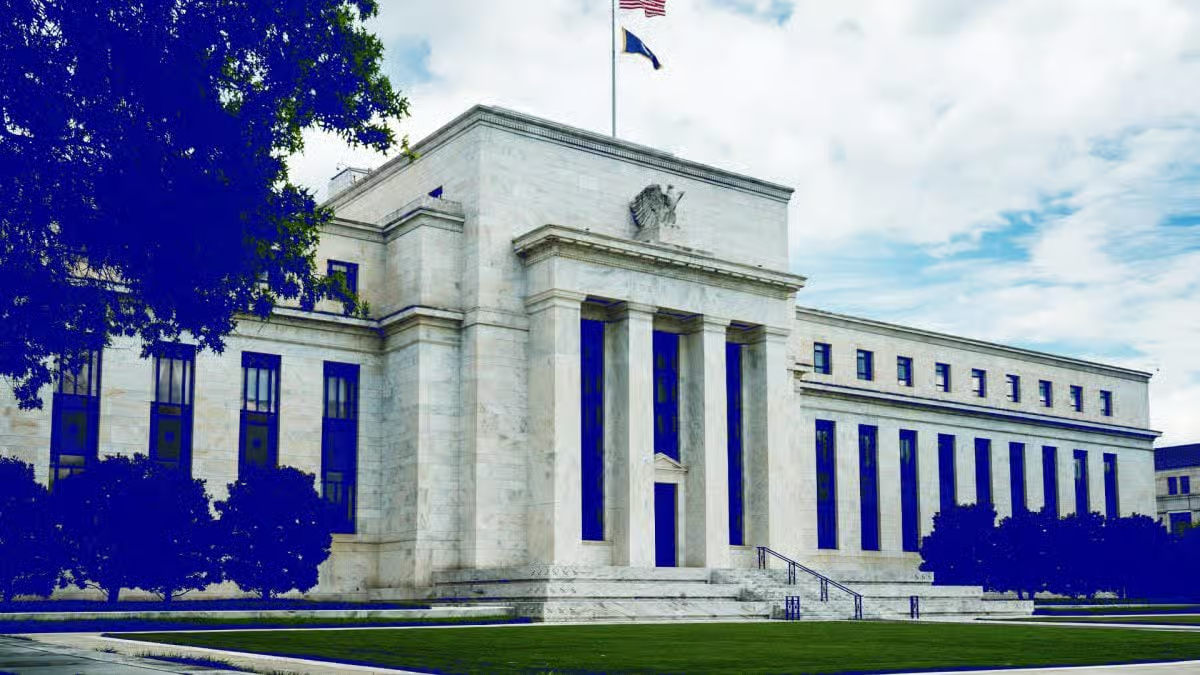
The Federal Reserve has issued a proposed rule requiring entities that issue stablecoins to establish and maintain a customer identification program. This initiative is part of the broader effort to implement the Guiding and Establishing National Innovation for U.S. Stablecoins Act, commonly referred to as the GENIUS Act, which was recently enacted into law.
Key Takeaways
- The Federal Reserve has proposed new regulations for stablecoin issuers, focusing on customer identification protocols.
- This rulemaking is a direct consequence of the recently passed Guiding and Establishing National Innovation for U.S. Stablecoins Act (GENIUS Act).
- The proposed rules aim to align stablecoin issuers with existing anti-money laundering (AML) and counter-terrorist financing (CTF) standards mandated by the Bank Secrecy Act.
- The proposal was developed in collaboration with other regulatory bodies, including the Office of the Comptroller of the Currency, the Federal Deposit Insurance Corporation, and the National Credit Union Administration.
- A majority of the Federal Reserve’s voting members approved the release of this proposal for public comment.
The proposed rulemaking, detailed in a 130-page document, seeks to integrate stablecoin operations more closely with the established compliance frameworks that traditional financial institutions are obligated to follow under the Bank Secrecy Act. This move signals a significant step towards formalizing regulatory oversight of the stablecoin sector, addressing concerns related to illicit finance and financial crime.
In addition to the Federal Reserve, the Office of the Comptroller of the Currency, the Federal Deposit Insurance Corporation, and the National Credit Union Administration have contributed to this proposed regulatory framework. This multi-agency approach suggests a coordinated effort to ensure comprehensive coverage and consistent application of the new requirements across the financial landscape.
Five members of the Federal Reserve’s central bank voted in favor of releasing the proposal. Federal Reserve Governor Michael Barr, while supporting the issuance of the proposal, expressed reservations regarding the scope of the GENIUS Act. He articulated concerns that the current legislative framework may not sufficiently address the risks associated with illicit finance within the secondary market transactions involving digital assets.
“While some digital asset service providers are subject to anti-money laundering and anti-terrorist financing requirements in their home jurisdiction, it is far too easy for bad actors to evade these restrictions and operate without detection when transacting in digital assets,” Barr stated in an official release.
Potential Regulatory Precedent and Legal Stakes
The Federal Reserve’s proposed rulemaking for stablecoin issuers carries significant implications for the nascent digital asset industry. By mandating customer identification programs, the central bank is essentially extending established Know Your Customer (KYC) and Anti-Money Laundering (AML) principles, mirroring requirements seen in traditional banking. This action underscores a global regulatory trend towards greater transparency and accountability within the cryptocurrency ecosystem.
The legal stakes for stablecoin issuers are substantial. Non-compliance with these proposed regulations could result in significant penalties, including fines and operational restrictions. Furthermore, the clear linkage to the Bank Secrecy Act implies that issuers could face scrutiny under existing financial crime legislation, potentially impacting their ability to operate within the U.S. financial system. For companies operating in this space, the imperative is to invest in robust compliance infrastructure to meet these evolving legal standards.
This development also sets a potential precedent for how other jurisdictions might approach stablecoin regulation. As countries worldwide grapple with integrating digital assets into their existing legal frameworks, the U.S. approach, particularly through the GENIUS Act and subsequent Federal Reserve actions, could serve as a benchmark. The emphasis on customer identification and AML/CTF compliance aligns with international efforts, such as the Markets in Crypto-Assets (MiCA) regulation in Europe, signaling a convergence towards harmonized global standards for digital asset oversight.
Source: : www.theblock.co