

Rendered illustrations circulating ahead of Apple’s Worldwide Developers Conference 2026 suggest a significant overhaul for Siri, the company’s long-standing virtual assistant. Leaked designs indicate the introduction of a dedicated Siri application, seamless integration with the Dynamic Island, and a powerful Google Gemini backbone, representing the most substantial evolution of the assistant in almost fifteen years. This development signals a strategic pivot towards advanced AI integration within the Apple ecosystem, potentially impacting the broader Web3 landscape by setting new standards for intelligent user interfaces.
- A dedicated Siri application with conversation history and richer interaction capabilities is expected.
- The Dynamic Island will feature enhanced integration, serving as a dynamic visual hub for Siri interactions.
- Core AI functionalities will be powered by Google’s Gemini models, a departure from Apple’s in-house development for this iteration.
- New system-wide interfaces, such as “Search or Ask,” aim to streamline user queries and device interaction.
- The update is positioned as a major advancement, addressing previous criticisms and aiming to revitalize Siri’s utility.
The upcoming iOS 27 is poised to redefine user interaction with Apple devices, moving beyond simple voice commands. The leaked designs, published by Bloomberg, showcase a Siri that is more conversational, integrated, and capable. The envisioned standalone Siri app will store conversation histories, offering a familiar chat interface. A new “Search or Ask” panel, accessible via a swipe down from the top of the screen, is set to replace the current Spotlight search, providing a more unified entry point for both information retrieval and task execution. This panel will also integrate dynamically with the Dynamic Island, expanding to offer rich results and interactive elements.
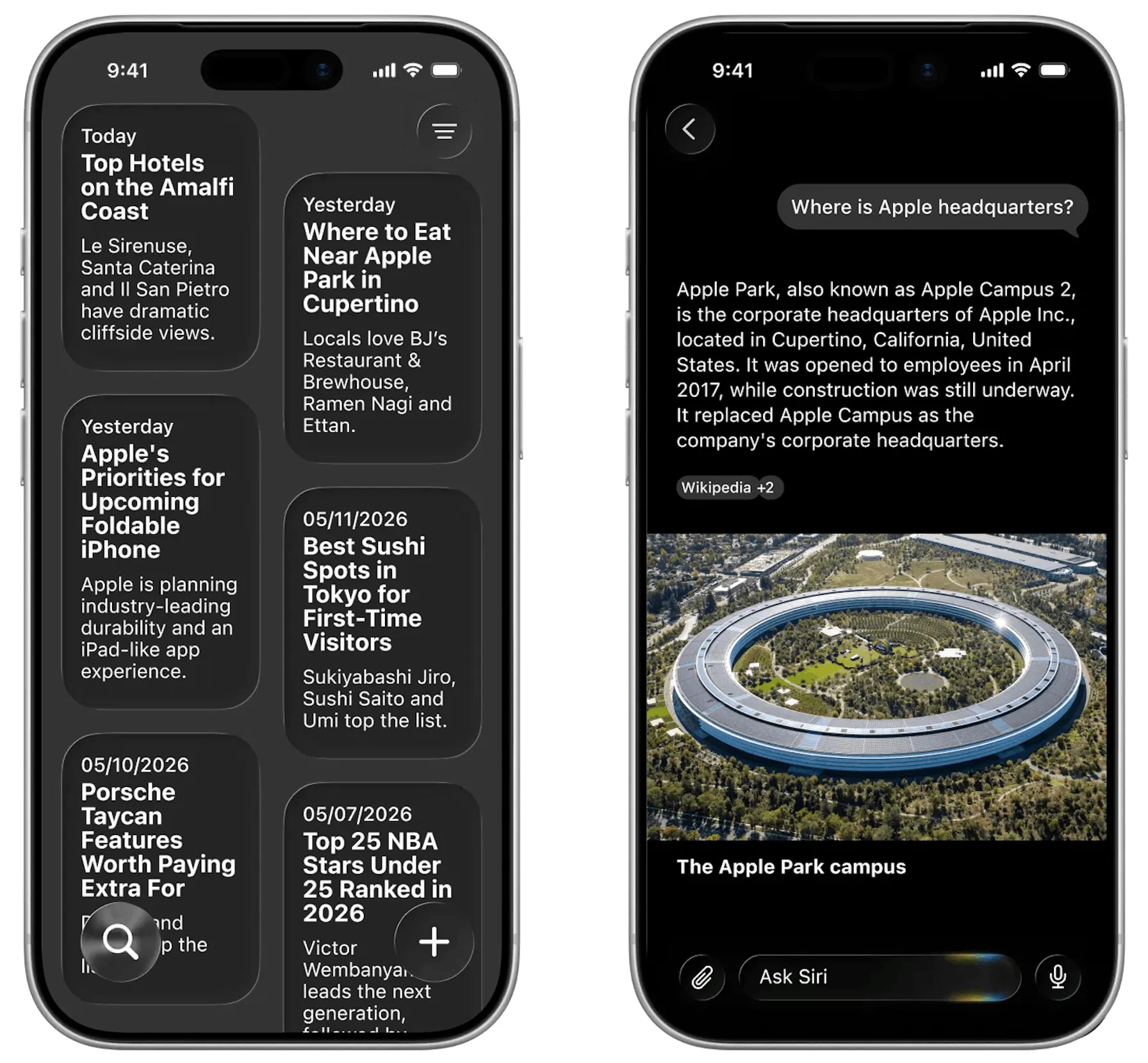
The integration of Google Gemini as the foundational AI for Siri is a notable development. This partnership highlights the increasing trend of cross-platform AI collaboration, crucial for advancing complex functionalities like natural language processing and context awareness. The dedicated Siri app itself is designed to be a versatile hub, supporting document and photo uploads, a persistent voice mode for continuous interaction, and a flexible query routing system. This system allows users to select between various leading AI models, including Google Gemini, ChatGPT, and Claude, directly from the interface, underscoring Apple’s move towards an open AI ecosystem. Furthermore, Apple is exploring allowing third-party AI agents from the App Store to integrate with Siri, potentially fostering innovation and user choice.
The journey to this advanced Siri has been protracted. Apple first previewed a “personalized Siri” at WWDC 2024, promising deep integration with user data. However, development faced significant hurdles, leading to a public delay in March 2025 due to quality concerns. This delay was followed by a class-action lawsuit alleging that Apple had advertised AI features that were not yet functional, resulting in a $250 million settlement. The reliance on Google Gemini addresses the technical challenges, while the multi-provider query system appears to be a strategy to pre-empt similar issues with future AI partnerships, ensuring users have direct access to the best available AI models.
Beyond core assistant functions, the updated Siri is expected to permeate other Apple applications. Renderings suggest a dedicated camera mode within the Camera app, allowing users to send captured images directly to third-party AIs for tasks like reverse image search or content analysis without leaving the application. This visual AI integration extends to other areas, with potential AI-driven editing tools in Photos, such as perspective adjustment and image extension, and AI-generated wallpapers. A natural-language interface for Shortcuts and a system-wide grammar checker are also anticipated, reflecting a broad push towards AI-enhanced user experience across iOS 27.

The camera integration is particularly significant as it foreshadows Apple’s future hardware developments. With camera-equipped AirPods and smart glasses in development, the iOS 27 Camera mode serves as a crucial foundational step, familiarizing users with visual AI interactions on a mobile device before extending it to wearables. This phased approach allows for iterative development and user adoption. The expected release of camera-enabled AirPods by late 2026 and smart glasses in 2027 suggests a concerted effort to embed AI capabilities more deeply into Apple’s product ecosystem. This strategic integration of AI across hardware and software, powered by robust foundational models, positions Apple to compete aggressively in the evolving landscape of intelligent personal assistants and extended reality devices, influencing the direction of blockchain and Web3 innovation through enhanced decentralized application interfaces and user experiences.
Long-Term Technological Impact
The strategic shift towards a multi-modal, deeply integrated AI assistant like the revamped Siri has profound implications for the future of technology, particularly at the intersection of AI, blockchain, and Web3. By leveraging a powerful LLM like Google Gemini and embracing an open ecosystem for AI agents, Apple is not only modernizing its own ecosystem but also accelerating the development of sophisticated AI-driven applications. This approach encourages a more distributed and specialized AI infrastructure, where different models excel at different tasks, mirroring the layered architecture seen in blockchain and Web3 development. The integration of visual AI and context-aware assistants further blurs the lines between the digital and physical worlds, paving the way for richer decentralized applications that can interact more intelligently with real-world data and user contexts. This could lead to more intuitive decentralized identity solutions, advanced smart contract execution based on multimodal inputs, and novel forms of digital ownership and interaction within metaverse and Web3 environments. The emphasis on user choice in AI providers also aligns with the decentralized ethos of Web3, potentially fostering competition and innovation in AI development, much like the open nature of blockchain technology has done for distributed ledger systems.
Learn more at : decrypt.co