

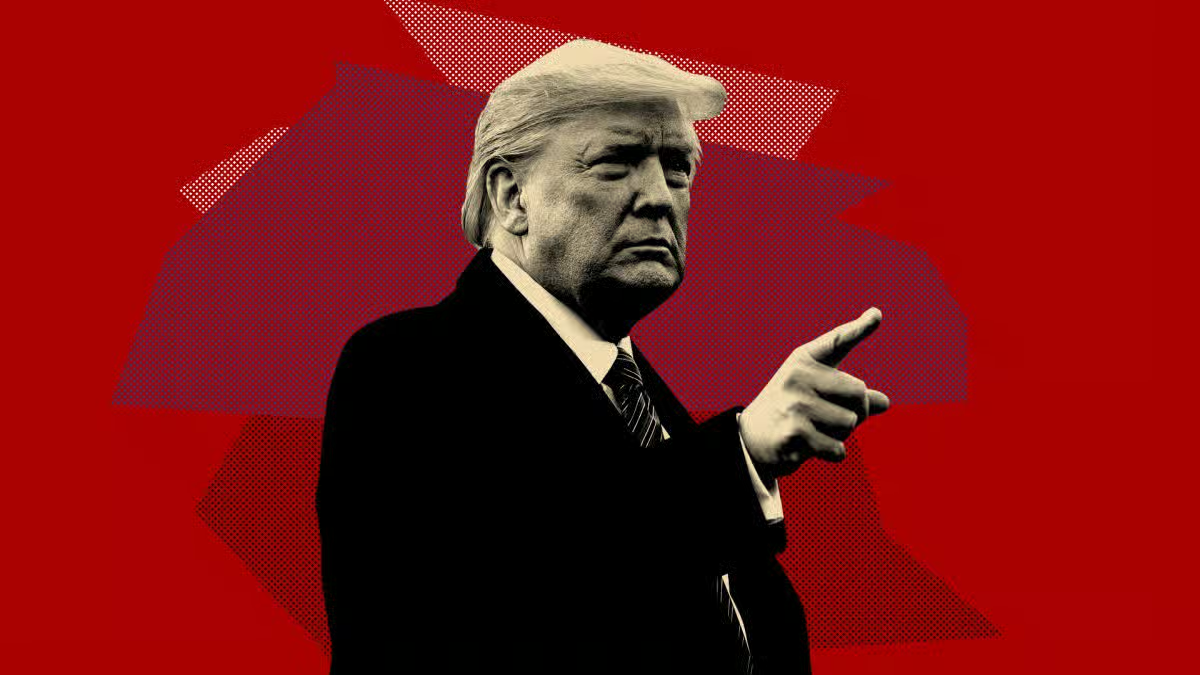
Former President Donald Trump has publicly affirmed his support for the Commodity Futures Trading Commission (CFTC) Chair Michael Selig, emphasizing the importance of maintaining the agency’s exclusive authority over prediction markets. Trump’s statement, made via Truth Social, aligns with Selig’s ongoing efforts to assert regulatory control over this rapidly evolving sector.
Key Takeaways
- Former President Donald Trump expressed strong support for CFTC Chair Michael Selig and the agency’s role in overseeing prediction markets.
- Trump highlighted the significance of maintaining the CFTC’s exclusive jurisdiction over these markets to ensure their continued growth and success.
- The statement also reiterated Trump’s general support for the cryptocurrency industry, referring to it as a “major industry” and emphasizing the U.S.’s desire to remain a global leader.
- CFTC Chair Selig has been actively pursuing expanded authority, including legal actions against states that have attempted to regulate prediction platforms.
- Recent reports have raised concerns about potential undue influence on CFTC decision-making regarding prediction markets and crypto firms with ties to the Trump family.
Selig has been a vocal advocate for the CFTC’s comprehensive jurisdiction over prediction markets, a stance that has led to legal challenges against five U.S. states: Wisconsin, Illinois, Arizona, Connecticut, and New York. These actions stem from the CFTC’s assertion that these platforms fall under its purview, despite pushback from state regulators who argue that such markets may violate existing gaming and gambling laws, particularly those related to sports betting. The CFTC has also initiated rulemaking processes to formalize its regulatory approach, underscoring its broad statutory interpretation.
Prediction markets, exemplified by platforms like Polymarket and Kalshi, have seen a significant increase in user engagement, particularly within the context of political events such as the 2024 U.S. presidential election cycle. This surge in popularity has intensified the debate over regulatory oversight and the appropriate legal framework for these novel financial instruments.
Trump’s endorsement extends beyond prediction markets to the broader cryptocurrency sector. He characterized crypto as a “major industry” and stressed the strategic imperative for the United States to maintain its position as the global leader in this field, warning against other nations attempting to usurp this role. This sentiment reflects a broader political discussion surrounding digital assets and their economic implications.
However, recent reporting has introduced complexities to this narrative. An investigative report published by The New York Times detailed allegations that career officials at the CFTC who had raised concerns about firms like Polymarket and Crypto.com, due to their business associations with the Trump family, were allegedly removed from their positions. These allegations have drawn sharp criticism from lawmakers, including Senator Richard Blumenthal, who publicly stated that the CFTC appeared to be serving as a “craven tool” for prediction markets and certain crypto firms, while potentially overlooking national security risks and engaging in retaliatory actions against staff.
Potential Regulatory Precedent
The ongoing efforts by CFTC Chair Michael Selig to assert exclusive jurisdiction over prediction markets, supported by former President Trump, could establish a significant regulatory precedent. Should the CFTC succeed in consolidating authority, it would signal a clear federal stance on these evolving financial products, potentially preempting or harmonizing a patchwork of state-level regulations. This could provide greater clarity for market participants and foster a more predictable environment for innovation and investment in this space. Conversely, if these assertions of authority face sustained legal or political opposition, it could lead to prolonged regulatory uncertainty and jurisdictional disputes, impacting the growth trajectory of prediction markets and potentially influencing how other novel digital asset-related activities are regulated in the future.
Original article : www.theblock.co