

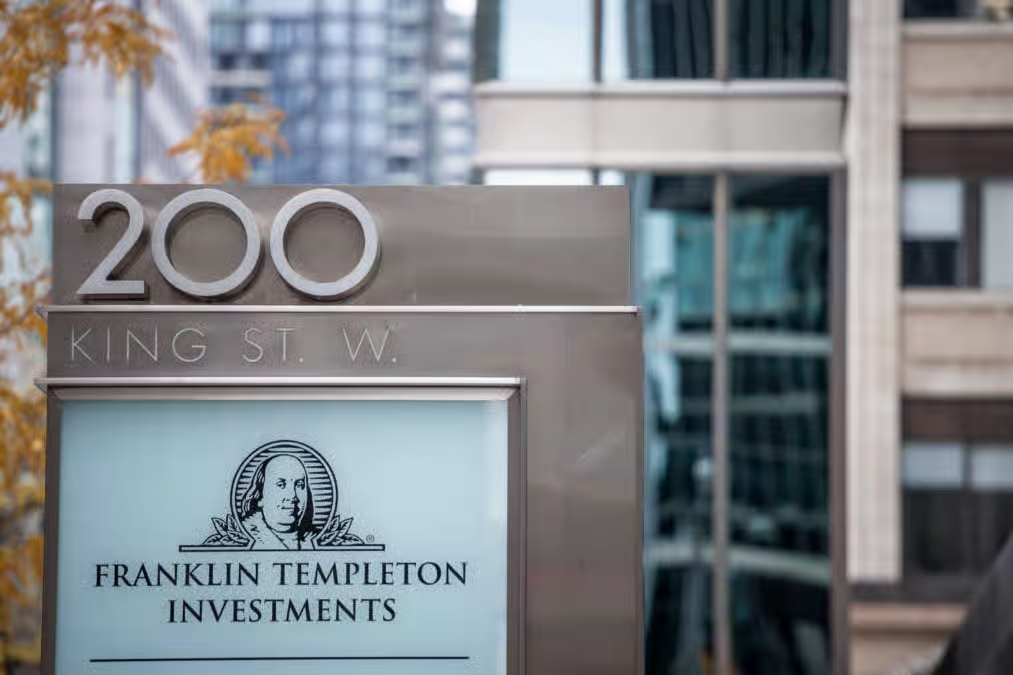
Global asset manager Franklin Templeton and Payward, the parent company of cryptocurrency exchange Kraken, have announced a strategic partnership aimed at developing and exploring new avenues for tokenizing traditional financial products. This collaboration signifies a deepening integration between established financial institutions and the digital asset sector, focusing on bridging the gap between conventional investment vehicles and blockchain technology.
Key Takeaways
- Franklin Templeton and Payward will jointly investigate methods for tokenizing traditional financial instruments.
- The partnership intends to explore offerings such as tokenized equities, qualified custody solutions, actively managed yield products, and access to institutional crypto liquidity.
- This collaboration highlights the ongoing convergence of traditional finance (TradFi) and digital asset markets.
- Payward is also pursuing a national trust company charter, indicating a broader strategy to integrate within the U.S. financial system.
- Franklin Templeton has existing involvement in crypto-related ETFs and tokenized funds, such as its BENJI money market fund.
The initiative will encompass the tokenization of various assets, including equities and yield-generating products designed for institutional clients. Furthermore, the partnership will leverage Kraken’s existing infrastructure, such as its Over-The-Counter (OTC) and Prime services, to provide institutional access to cryptocurrency liquidity. The firms have characterized this alliance as a clear demonstration of how traditional finance and digital asset markets are merging in practical application.
Both entities plan to explore the creation of novel tokenized versions of Franklin Templeton’s existing financial products. These could include yield products tailored for institutional investors. The companies also indicated a potential to extend certain offerings to Kraken’s wider user base, where appropriate. Kraken already offers a feature named xStocks, which provides tokenized equities and has reportedly facilitated over $30 billion in trading volume since its inception.
Arjun Sethi, co-CEO of Payward and Kraken, stated, “Payward and Franklin Templeton are building toward a model of finance where the distinction between traditional assets and digital infrastructure no longer holds. The convergence between these two worlds is only going to deepen, and what collaborations like this one unlock is a new class of products that wouldn’t have been possible even three years ago.”
In parallel with strengthening its ties to traditional finance, Payward has also initiated the process of applying for a national trust company charter with the Office of the Comptroller of the Currency (OCC). This regulatory step, if successful, would grant Payward enhanced access and operational capabilities within the U.S. financial regulatory framework.
Franklin Templeton has previously demonstrated its engagement with digital assets through its issuance of crypto-based Exchange Traded Funds (ETFs) that track the price movements of digital currencies like Bitcoin and XRP. The firm also offers BENJI, a tokenized iteration of its money market fund, and is collaborating with Ondo Finance on other tokenized product initiatives.
Sandy Kaul, Head of Digital Assets & Innovation at Franklin Templeton, emphasized the strategic direction, noting, “The focus should be on making onchain assets more functional for the full range of market participants once they are there.”
Potential Regulatory Precedents and Compliance Considerations
This partnership between Franklin Templeton and Payward could set significant regulatory precedents, particularly within jurisdictions still defining their frameworks for digital assets and tokenized securities. The involvement of a major asset manager like Franklin Templeton in tokenizing traditional products signals a maturation of the sector, but also brings existing regulatory scrutiny to bear. Companies engaging in such activities must ensure strict adherence to securities laws, KYC/AML regulations, and potentially new compliance standards introduced by frameworks like Europe’s Markets in Financial Instruments Regulation (MiCA) or evolving U.S. SEC guidance.
The legal stakes involve navigating complex regulatory landscapes that vary globally. For issuers, the primary concern is ensuring that tokenized products are classified and treated appropriately under existing securities laws, avoiding unregistered offerings. For platforms like Kraken, providing custody and trading services for these tokenized assets requires robust compliance programs to prevent illicit activities and protect investors. The OCC charter application by Payward further underscores the intricate process of integrating digital asset operations within traditional banking and financial structures, requiring a thorough understanding of capital requirements, risk management, and consumer protection laws.
Original article : www.theblock.co