

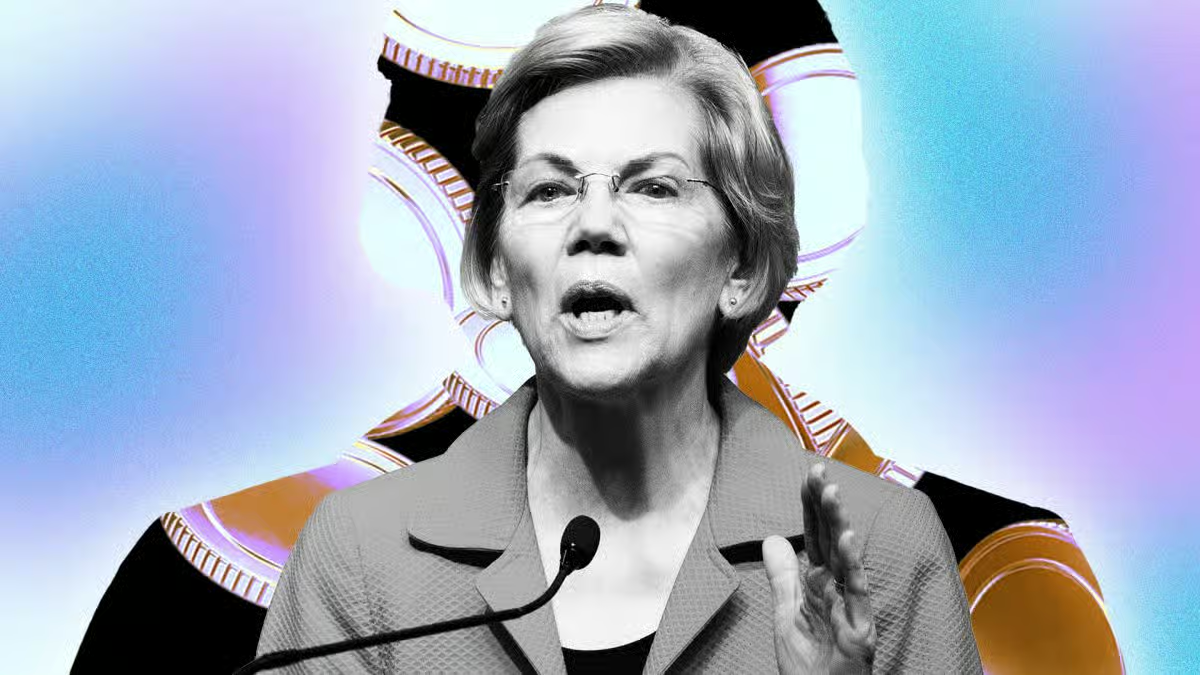
Senator Elizabeth Warren has formally requested detailed information from Meta CEO Mark Zuckerberg concerning the company’s reported plans to integrate a third-party stablecoin into its extensive social media platforms. The inquiry highlights significant concerns surrounding financial stability, competition, and user privacy within Meta’s ecosystem, which encompasses over 3.5 billion users.
Key Takeaways
- Senator Elizabeth Warren is seeking transparency from Meta regarding its plans to integrate a stablecoin by mid-2026.
- Concerns raised include potential impacts on financial stability, consumer privacy, and market competition.
- This initiative marks Meta’s second attempt at stablecoin-related ventures, following the earlier Libra project.
- Warren has posed seven specific questions to Meta, requesting responses by May 20.
- The inquiry occurs amidst growing global adoption of stablecoins as a transactional tool.
The Senator’s letter emphasizes the potential ramifications of Meta’s involvement in stablecoin operations, particularly given the company’s past attempts with the Libra project, which faced considerable regulatory and political opposition. Warren cautioned that any move by Meta to control, influence, or favor a specific stablecoin could negatively affect market competition, compromise user data privacy, and introduce risks to the integrity of payment systems and overall financial stability.
Warren’s letter references reports indicating that Meta is currently conducting a limited trial of a third-party stablecoin. This trial is reportedly a precursor to a larger rollout planned for the latter half of 2026. The Senator pointed out that Meta’s previous endeavor, the Libra project launched in 2019, was met with bipartisan criticism due to concerns it could allow the company to exploit transaction data for advertising purposes and effectively operate as a “private central bank.” The potential for taxpayer-funded bailouts in case of a stablecoin run was also cited as a significant risk.
While Meta previously informed lawmakers in June 2025 that it had no intentions of issuing its own stablecoin, Senator Warren noted that the company had not disclosed its commercial arrangements with third-party stablecoin issuers or any potential modifications to its MetaPay wallet that would facilitate stablecoin usage.
“It is critical that Meta be transparent with Congress and the public regarding its stablecoin-related plans,” Warren wrote. “Beyond the failure of its previous attempt to issue its own global private currency, the company has struggled to safely offer its existing products and services.” She further criticized Meta for prioritizing profits over user privacy and highlighted a history of anticompetitive practices, suggesting that any expansion into financial services by the company warrants significant scrutiny.
Regulatory Precedent and Compliance Demands
Senator Warren’s detailed inquiry sets a precedent for how regulators may approach oversight of major technology companies entering the digital asset space. The seven specific questions posed to Zuckerberg highlight key areas of regulatory focus: the structural integrity of the trial, the implementation of robust risk management controls, the timeline for the proposed launch, and Meta’s business model concerning stablecoin integration. The Senator is particularly interested in whether MetaPay will be adapted to allow users to hold stablecoins, the selection criteria for third-party stablecoins, and the existence of profit-sharing or transaction-based compensation structures. Crucially, Warren seeks assurances that Meta will not discriminate in favor of a particular stablecoin and will maintain strong privacy and illicit finance controls. The commitment to refrain from issuing its own private currency, which Meta stated it would not do, is also being re-affirmed.
The questions surrounding the potential preference for a specific stablecoin and the integration with MetaPay touch upon compliance with existing financial regulations and competition laws. The demand for transparency regarding risk management and illicit finance controls aligns with global regulatory frameworks such as the European Union’s Markets in Crypto-Assets (MiCA) regulation, which imposes stringent operational and compliance requirements on crypto-asset service providers and issuers. Companies like Meta, intending to leverage their vast user bases for financial services, will face increased scrutiny regarding their adherence to these evolving global standards. The legal stakes for Meta involve not only potential fines and operational restrictions but also the risk of damaging its reputation and user trust if its stablecoin initiatives are perceived as non-compliant or harmful.
The broader context of stablecoin adoption underscores the increasing importance of clear regulatory guidance. A recent report indicated that 54% of crypto users have held stablecoins in the past year, with holders allocating significant portions of their savings to these assets. The total dollar-pegged supply has surpassed $303 billion, with major stablecoins like Tether (USDT) and Circle’s USDC accounting for substantial portions. Industry figures suggest that the involvement of large tech firms could further accelerate this growth. However, this expansion necessitates a robust and coherent regulatory approach to mitigate risks and ensure the stability and integrity of the digital asset market.
Original article : www.theblock.co