


 Prefer us on Google
  Download App
  Download App
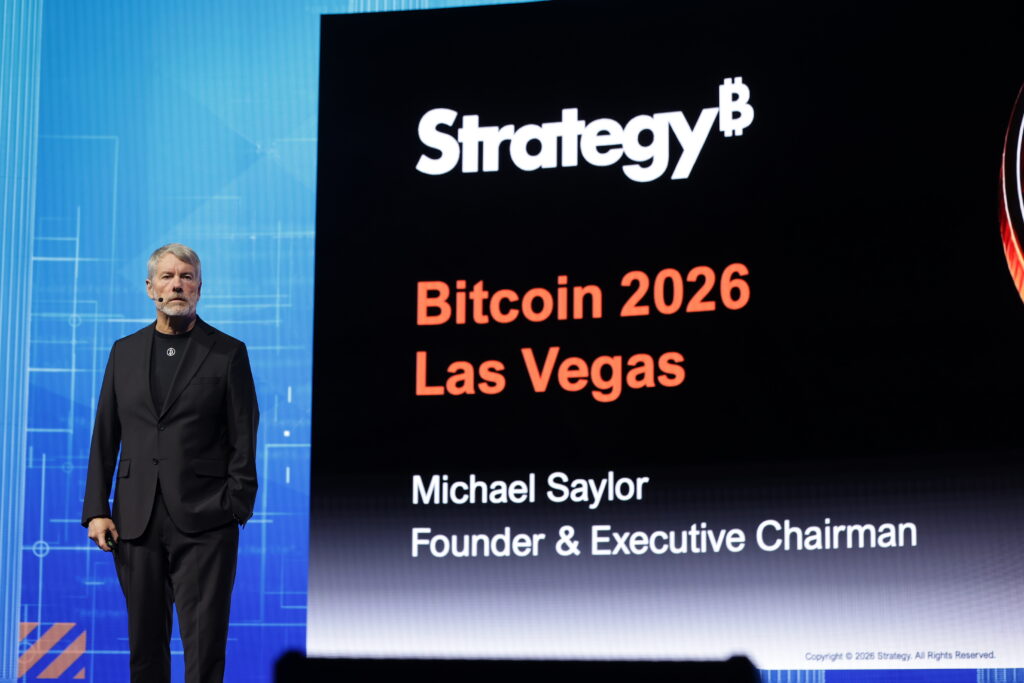
Michael Saylor, the founder and executive chairman of Strategy, addressed the Nakamoto Stage at Bitcoin 2026 on Tuesday, asserting that a preferred stock instrument, just nine months old, has emerged as the world’s most rapidly expanding credit product and that its growth is far from over.
The keynote address, centered on what Saylor terms digital credit, served as a structured proposal for STRC, Strategy’s Variable Rate Series A Perpetual Stretch Preferred Stock. This instrument is listed on Nasdaq, trades near its $100 par value, and offers a 11.5% annualized monthly dividend.
He commenced with a foundational statement that set the stage for his subsequent remarks: “The world is built on capital. The world runs on credit.”
Saylor posits Bitcoin as the capital layer, which he defines as “ideal capital” – meticulously designed, digital, easily transferable, and historically superior to other options. He highlighted Bitcoin’s approximate 38% annualized return over the last five years, contrasting it with gold, the S&P 500, and real estate, which he unequivocally described as “awful.”
JUST IN: Michael Saylor said their BTC accumulation machine STRC "grew to be the largest preferred stock in the world within 8 months" 🤯
They're using STRC to mass buy as much bitcoin as they can 🚀 pic.twitter.com/ElyFJFAvSc
— Bitcoin Magazine (@BitcoinMagazine) April 28, 2026
Within his model, STRC represents the credit layer built upon Bitcoin. It effectively neutralizes Bitcoin’s volatility, channels the surplus returns to common equity holders, and provides investors seeking income rather than price appreciation with what he described as a “comfortable ride.”
The distinction he drew between digital credit and conventional private credit was one of the most compelling arguments presented. He characterized private credit as illiquid, obscure, fragmented, and burdened by fees, primarily structured to benefit issuers. Conversely, he defined digital credit as liquid, transparent, uniform, expandable, readily accessible, and free of fees.
“We engineered a digital instrument that benefits the investor,” he stated, positioning STRC as a structural remedy to the inherent incentive misalignments in private markets.
He placed this innovation in a historical context, drawing a parallel to preferred capital in 19th-century American railroads, where it constituted 20% to 30% of institutional financing before its decline. Saylor asserted that Strategy has revitalized this model for the 21st century, built upon Bitcoin rather than railroad infrastructure.
STRC’s $8.5 Billion Dominance
The financial figures he presented on the Nakamoto Stage were central to his presentation. STRC achieved a notional value of approximately $8.5 billion within nine months, a sum that alone would surpass the total existing market value of all monthly-paying preferred securities combined.
He indicated an annual growth rate for the program of around 350%, noted that April inflows alone, when projected annually, suggest a figure of $38 billion per year, and described the product as being in a state of “hypergrowth” with no foreseeable limits. He added that liquidity has increased eightfold over five months.
“This is going viral,” he declared to the assembled audience.
Saylor: STRC is Accessible
A key factor contributing to this rapid adoption, according to Saylor, is its accessibility. STRC is traded on Nasdaq and is available to any retail investor, whereas the majority of comparable structured credit products are either confined to private funds or restricted to institutional purchasers.
He revealed that approximately 80% of STRC holders are retail investors, though he noted that corporate treasuries and institutions are beginning to participate. Strategy’s internal data indicates that STRC has facilitated the acquisition of roughly 77,000 BTC year-to-date in 2026, which is ten times the net inflow of all U.S. spot Bitcoin ETFs combined during the same timeframe.
The tax implications were presented as another significant advantage. STRC dividends qualify for return-of-capital treatment, allowing investors to reinvest cash distributions without incurring immediate ordinary income tax on the full amount, thereby enabling compounding returns over time.
Saylor concluded by presenting a broader vision extending beyond any single product. He observed a “great thirst in the crypto economy to generate Bitcoin-backed yield” and highlighted the opportunity for 1,000 companies to develop their own digital monetary and yield instruments based on this framework.
“Every dollar that flows into digital credit will flow into digital capital,” he stated. “It will flow into the Bitcoin network. As it flows into the Bitcoin network, the price will increase.”
“We anticipate digital credit to drive the scale of the Bitcoin network… propelling Bitcoin to $10 million per coin, establishing Bitcoin as a $2 trillion network before further growth, and offering individuals an alternative to 20th-century credit instruments,” Saylor remarked.
He characterized this movement as “a massively powerful, multi-generational wealth transfer” and articulated his ultimate objective as Strategy’s model being utilized to “power hundreds of millions of households with a high-yield savings account.”
Details can be found on the website : bitcoinmagazine.com