

 Prefer us on Google
  Download App
  Download App
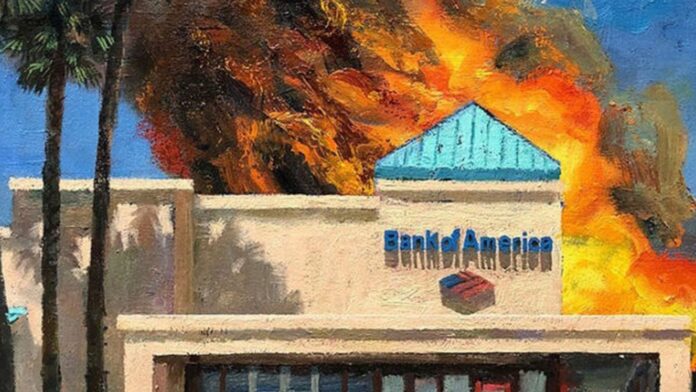
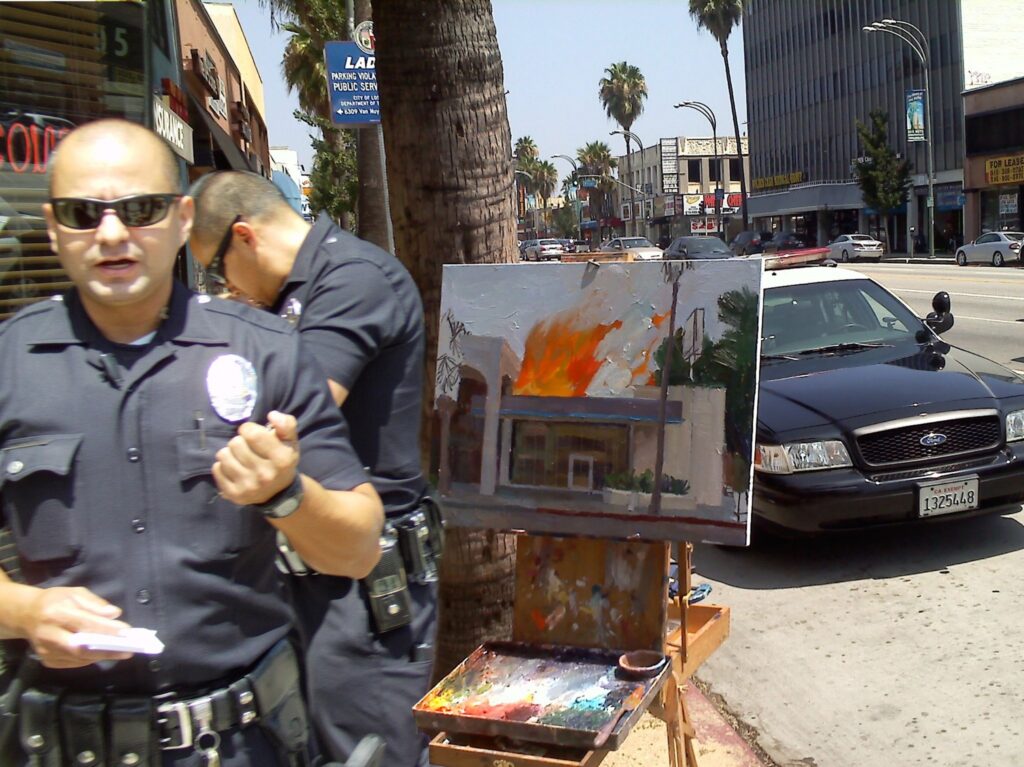
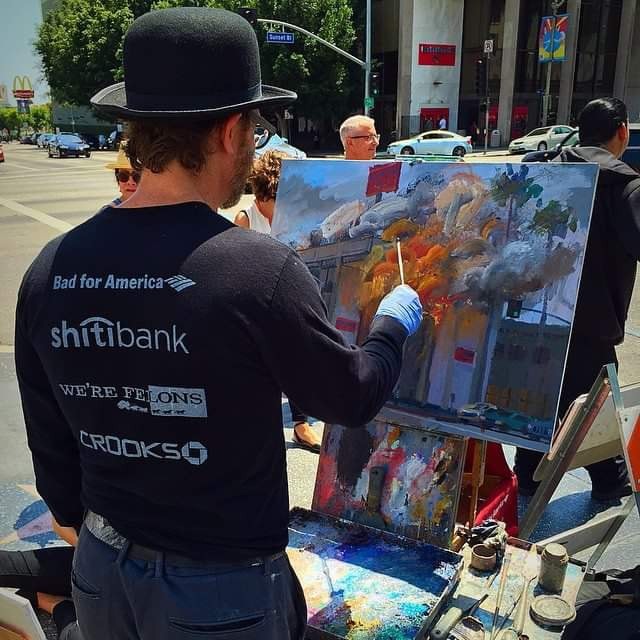
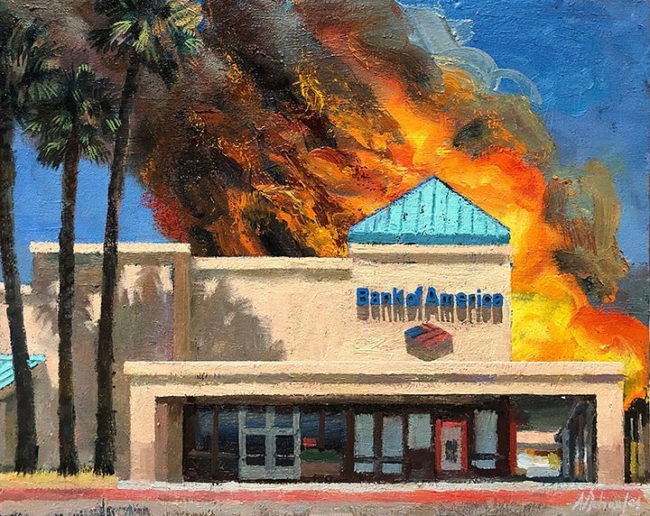
Revolutions leave behind vestiges. During the summer of 2011, a painter named Alex Schaefer positioned an easel on a public walkway in Van Nuys, California, and commenced painting the Chase Bank branch situated across the thoroughfare. In his artistic vision, the edifice was engulfed in flames — infernos erupting from the windows, dark smoke billowing above the palm trees, the Chase insignia still discernible through the intense heat. He worked outdoors, in the style of the Impressionists who captured scenes along the Seine and through verdant fields, but his subject was a branch of America’s largest financial institution, just three years removed from a taxpayer-funded bailout. A bystander alerted the authorities. Upon the sale of the artwork on eBay for $25,200 to a collector in Germany, Schaefer embarked on a logical course of action: he painted more.
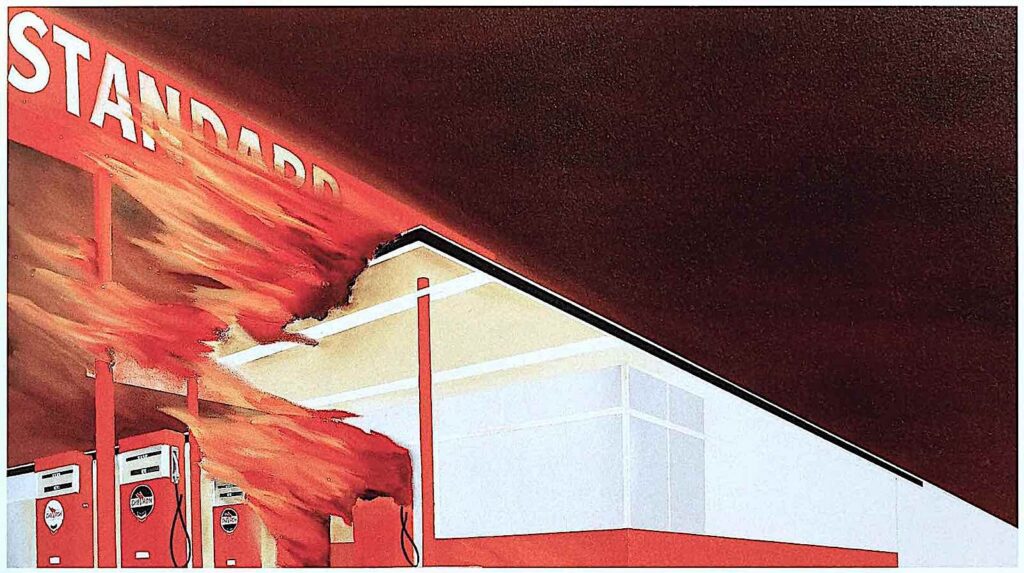
The artistic creations assembled in “Relics of a Revolution” at Bitcoin 2026 chronicle a history of defiance that links grassroots activism to the very inception of Bitcoin. This lineage includes a snow-covered Tokyo sidewalk with Kolin Burges, an overpass in Los Angeles adorned with wheatpaste art by Mear One, and a bungled police raid in Ohio met with songs and a flag suit by Afroman. Schaefer’s “Banks on Fire” paintings are part of this same historical thread, and they arrive with an art-historical lineage that amplifies their significance. Art critics have identified a clear connection to Ed Ruscha’s “Los Angeles County Museum on Fire” (1965–68), a painting that depicted a cultural institution ablaze and was subsequently displayed within that very museum. Schaefer substituted the museum for the bank, the era of oil crises for the era of bailouts, and moved the act of painting from the studio to the public sidewalk directly in front of the subject—a fact that led to his interrogation by LAPD officers who suspected him of being a terrorist planning to enact his canvases. “Some might argue that the banks are the actual terrorists,” he informed them. In July 2012, he was apprehended outside a downtown Chase branch for inscribing the word “Crooks” adjacent to the bank’s emblem, spending twelve hours in custody on a minor vandalism charge.
Born in Los Angeles in 1969 and educated at the ArtCenter College of Design in Pasadena, Schaefer dedicated eight years to digital art, including work on the original Spyro the Dragon series, before transitioning from the screen to the canvas. He later returned to ArtCenter to instruct on the foundational principles of painting, drawing, and composition. Similar to Mear One, he spent considerable time working from his studio in downtown Los Angeles, a district that became the epicenter of a decade of American societal upheaval. Occupy LA established a camp on the City Hall lawn, a short distance from his studio; the nationwide chalk protests of 2012 had a significant focal point outside a downtown Chase branch; and the vicinity of 5th and San Julian remained a stark indicator of the inadequacies of every system the bailouts were intended to rectify.
The “Banks on Fire” series commenced in 2009, in the immediate aftermath of the financial meltdown. “All the nation’s problems,” he has stated, “seem to me to stem from a single root cause: the currency is worthless.” The Bitcoin community discovered him swiftly, and for evident reasons. The headline embedded in the Genesis Block—“Chancellor on brink of second bailout for banks”—represents the same diagnosis in text that Schaefer conveyed through oil paint on the sidewalk, while the structure still stood.
I convened with Alex Schaefer prior to his participation in a panel discussion at Bitcoin 2026 to discuss outdoor protest art, the 2008 financial crisis, the architectural implications of bailouts, and the act of depicting a building aflame while it remains intact.
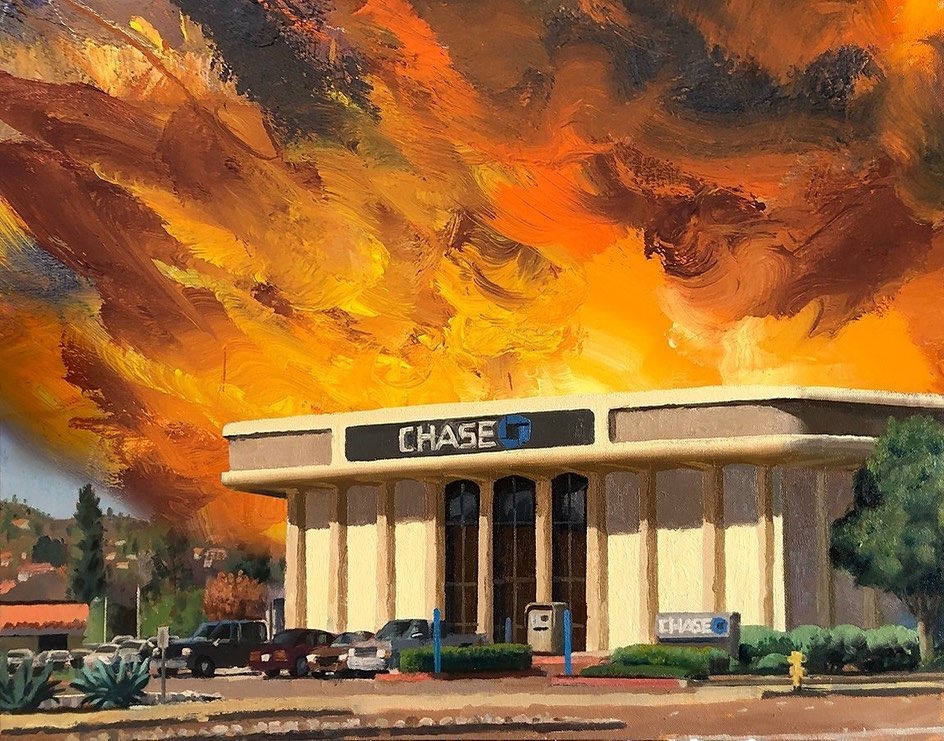
BMAG: Alex, you initiated the “Banks on Fire” series in 2009—not within a studio, but outdoors on the pavement, en plein air, directly facing the structures themselves. For those encountering this art for the first time, could you describe the context? What was transpiring nationally when you first set up your easel across from a Chase branch, and why did the sidewalk prove to be the appropriate venue for your work?
Alex: In 2009, I was engaged in (and continue to appreciate) “plein air” painting, which involves creating art outdoors, directly from observation. This method is closely linked to the French Impressionists and is a highly rewarding pursuit. As I resided in Los Angeles at the time, my preferred subject was the urban landscape, and I was accustomed to setting up my easel and art supplies on sidewalks, thus making art in public spaces was a familiar practice. Concurrently, in 2009, I began to focus intently on financial news, initiating a journey of learning that persists to this day. It slowly dawned on me that the 2008 financial crisis and the subsequent multi-trillion dollar bailouts were not as they were presented to us. Around this time, a friend introduced me to a show called the Keiser Report. Max and Stacy, along with various other news and information sources on YouTube, began to educate me with sharp wit and profound insight into the actual unfolding events. My sole conclusion was inescapable: this constituted a criminal enterprise, and not only were the perpetrators evading consequences, they were being compensated. It was outrageous. It ran counter to American values, capitalism, and the rule of law. A couple of years later, duly radicalized, I sought an outlet for my indignation. I was frequently painting en plein air, particularly with a friend who resided in Van Nuys. In his neighborhood, I encountered a Chase Bank that had previously been a Washington Mutual, which in turn had been a Home Savings and Loan. It was a magnificent mid-century modern structure designed by Millard Sheets. This became the serendipitous convergence of my artistic inclination and the subject matter: I resolved to paint this Chase Bank en plein air as if its roof were ablaze. The following day, I captured this image:
BMAG: A connection is frequently drawn between your artistic creations and Ed Ruscha’s “Los Angeles County Museum on Fire”—a piece that depicted a cultural establishment engulfed in flames and was subsequently exhibited within that institution itself. You have recontextualized this by replacing the museum with a bank, the era of the oil crisis with the period of bailouts, and by moving the artwork from a private studio to the public sidewalk. When you consider this artistic lineage, do you perceive yourself as continuing a dialogue initiated by Ruscha, or as identifying a malady that he could not have foreseen in the 1960s—specifically, the pervasive corruption within a financial system that now dictates cultural norms previously upheld by that system? Does this situation echo past events?
Alex: I believe a shared element between the two works is their genesis in a sentiment of outrage. However, they diverge in that one addresses financial malfeasance, while the other pertains to a lack of representation for artists within institutions. Ruscha created his piece between 1965 and 1968, a period coincidentally marked by significant pressure exerted by France on the U.S. dollar through the exchange of paper currency for physical gold, which represented an extraordinary advantage in a manipulated market at the time. The inflationary pressures were palpable, undoubtedly affecting Ed Ruscha as well, stemming from imprudent government expenditures, both domestic and foreign. The French were aware of the underlying reasons (the Vietnam War), and a few years later, Nixon severed the gold standard, unleashing an unprecedented era of unchecked monetary expansion. Ironically, this shift benefited the high-end art market through the CIA’s influx of capital into contemporary American art auction houses, promoting the narrative of American Exceptionalism; the implication being that not only did America surpass the communists in reaching the Moon, but its art was also superior (i.e., more valuable). 1973 witnessed the notable Bob Scull auction of his contemporary art collection, which shattered all previous price records. The game was afoot.
BMAG: While you were engaged in your painting, the LAPD questioned you as a potential terror suspect. Furthermore, in 2012, you were apprehended for using chalk to write “Crooks” next to a Chase logo, resulting in a twelve-hour jail stay on a misdemeanor vandalism charge. Mear faced censorship and near-cancellation. Kolin was informed by Mt. Gox that persistent protests could jeopardize everyone’s bitcoin holdings. Afroman experienced a home invasion by seven deputies armed with assault rifles. What insights did these experiences of being perceived as a threat by the state provide you regarding the artwork itself—and concerning the anxieties of the institutions you were depicting?
Alex: The established powers, the institutions, desire for the populace to direct their animosity towards one another. Envision those hierarchical pyramid diagrams; on one tier rests “The Public,” and ascending above them are strata such as the Police, the Justice System, Politicians, C-Suite Executives, Banks, Central Banks, and ultimately, perhaps, Satan. Each level above “The Public” has, over centuries, devised methods to exert dominance over Us, for a myriad of reasons, but primarily because they fear Us directing the totality of our collective anger towards the aforementioned upper echelons. They employ their favored stratagem: dividing “The Public” into disparate factions, each endowed with bespoke grievances and designated scapegoats. Subsequently, the mainstream media fulfills its role by agitating individuals on both sides, resulting in animosity directed laterally and amongst Ourselves, rather than upwards. The moment an individual within “The Public” tier begins to call out an injustice originating from an upper tier, they will inevitably encounter difficulties. Everyone you mentioned—Mear, Kolin, Afroman, First Amendment auditors, tax protesters, and others—is fully aware of this dynamic. My involvement with this ongoing “Burning Banks” series has imparted numerous lessons over the years concerning art, the art world, the financial sphere, Truth, Justice, the American Way, and so forth. These lessons encompass both profound and unsettling insights. However, the primary lesson derived is the potent influence of spectacle; and when an overwhelming urge compels you to undertake an action, even if it appears somewhat unconventional or daunting, you must embrace it.
BMAG: You have unequivocally stated that “the money is bullshit”—that all of America’s disparate issues trace back to a singular fundamental problem. How did you arrive at this conclusion, and upon your initial encounter with Bitcoin, did it strike you as a confirmation of your existing artistic narrative, or as a distinct resolution to the same inquiry?
Alex: I would more precisely assert that “fiat” currency, also known as legal tender or the Federal Reserve note, is fraudulent. Fiat currency was conceived centuries ago to finance warfare, and the U.S. PetroDollar is no exception. Perpetual conflicts, wars of aggression, the War on Drugs, the War on Cancer—whatever you name it, there is an ongoing conflict, either in support of or in opposition to it, and ultimately, all of it is financed by the Federal Reserve. Every egregious policy proposed by our so-called leaders receives funding. It is accurate that “The love of money is the root of all evil,” but in the case of the U.S. Dollar, it is the currency itself, not merely the affection for it, that is the source. Its creation ex nihilo and its implications demonstrate a profound lack of regard and disrespect for the value of human life and labor. Despite this, civilization requires a functional medium of exchange. Sound money, specifically. The social construct of money predates capitalism; it is, in fact, as ancient as society itself and serves as the mechanism through which complex, specialized societies can form, grow, and thrive. For millennia, this role was fulfilled by gold and silver, which possess the classical attributes of Sound Money: scarcity, fungibility, portability, divisibility, durability, and serves as a unit of account and medium of exchange. Once this fundamental understanding is accepted, upon learning about Bitcoin, it gradually, then suddenly, becomes apparent that it represents the most significant evolution of the concept of Money ever conceived. Consequently, one begins to genuinely believe that by rectifying our monetary system, we can truly ameliorate the world! Defund Evil!
BMAG: This exhibition is titled “Relics of a Revolution,” and it places your artwork in dialogue with Kolin Burges’s Mt. Gox protest sign, Mear One’s Occupy-era murals and wheatpaste posters, and Afroman’s flag suit—alongside an original copy of The Times from January 3, 2009, the newspaper Satoshi Nakamoto embedded within the Genesis Block. The dollar bill artworks you are presenting here pursue a distinct avenue toward the same fundamental argument. What do you hope an individual experiencing this exhibition will come away with—particularly someone who perceives Bitcoin merely as a price indicator and has not considered its role as a continuation of a protracted struggle waged by artists, cypherpunks, and activists for decades?
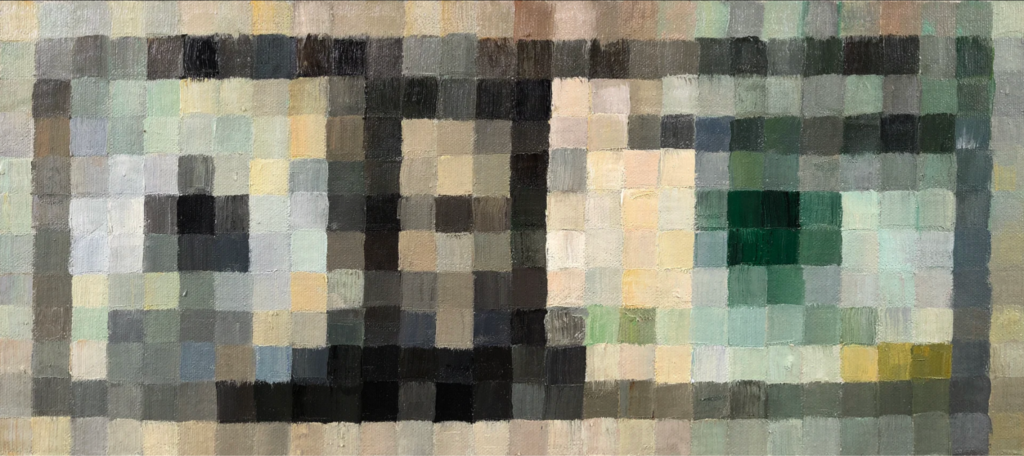
Alex: Candidly, as with all my paintings, my initial objective is for viewers to be visually captivated… Whether by the texture of the paint, the color palette, the contrast, the play of light, or the imagery itself, the artwork should first engage the eyes, and subsequently, the intellect. I find the low-resolution, pixelated quality of the “Devaluation” series pieces to be visually compelling. An intriguing interplay unfolds between the viewer’s eye and mind; the painting is complete in itself, yet it is also “completed” within the viewer’s imagination. The viewer contributes more to the image through their own imaginative faculties than is explicitly conveyed by the artwork. “Am I perceiving what I believe I am perceiving?” Subsequently, one might contemplate the subject matter and its representation through the lens of Devaluation. At what juncture does a painting become so pixelated that its subject is no longer discernible? Similarly, at what point does the Dollar become so diluted, extended, and misrepresented that it entirely loses its “Tinkerbell Effect” and ceases to fulfill its critical function globally? We may soon discover the answer.
This segment is the fourth installment in the “Relics of a Revolution” interview series, accompanying the exhibition of the same name. Part I features Kolin Burges, Part II Mear One, and Part III Afroman.
Rectify the monetary system. Rectify the world.
Schaefer will showcase his art at Bitcoin 2026, scheduled from April 27–29 at The Venetian Resort in Las Vegas. He will also participate in a panel discussion, moderated by Dennis Koch and titled “Looking at Bitcoin Art Through a Protest Lens,” alongside Kolin Burges and Mear One. You can place bids on Schaefer’s artwork HERE.
The Bitcoin Museum & Art Gallery (BMAG) functions as the curatorial and cultural programming division of BTC Inc and the Bitcoin Conference. Since 2019, the BMAG conference art gallery has facilitated the sale of over 120 BTC worth of art and collectibles. Discover more about BMAG at museum.b.tc. Follow BMAG on Twitter @BMAG_HQ.
Secure your Bitcoin 2026 pass bundled with accommodation at The Venetian and receive your fourth night complimentary. Utilize the code AFTERS for a complimentary After Hours Pass, or acquire your pass independently here.
Based on materials from : bitcoinmagazine.com