

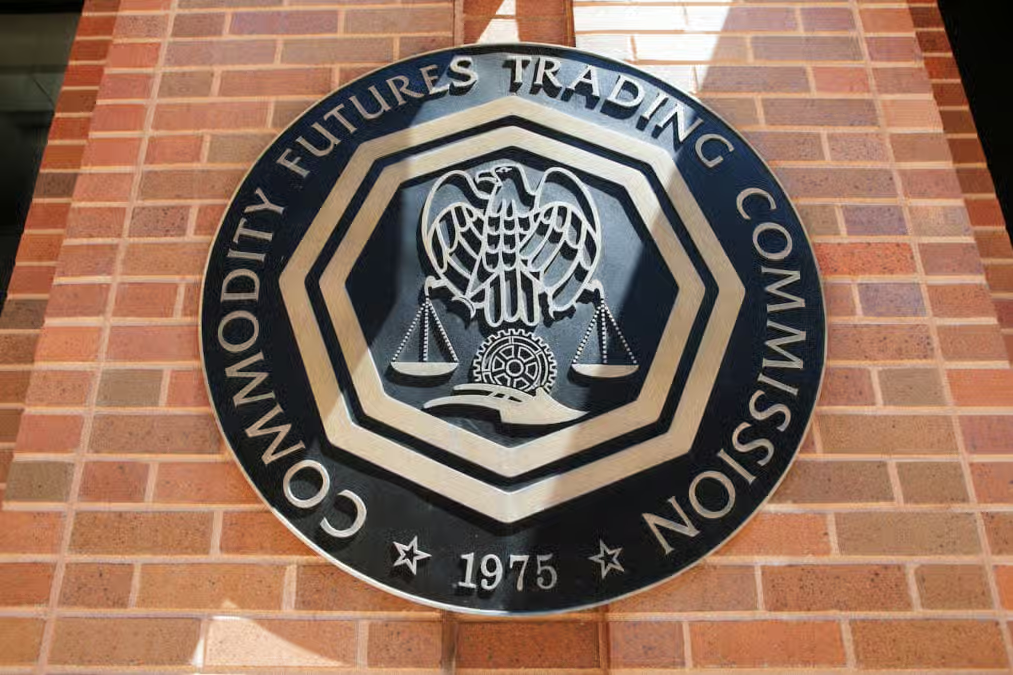
The Commodity Futures Trading Commission (CFTC) has initiated legal action against Wisconsin’s top officials, including Governor Tony Evers, Attorney General Joshua Kaul, and John Dillett, the administrator of the Wisconsin Department of Administration Division of Gaming. This lawsuit, filed in the U.S. District Court for the Eastern District of Wisconsin, represents the CFTC’s fifth legal challenge in the past month against states attempting to regulate prediction markets. The agency asserts its exclusive jurisdiction over these markets, directly confronting state-level attempts to classify them as illegal gambling or public nuisances.
Key Takeaways
- The CFTC has filed a lawsuit against Wisconsin Governor Tony Evers, Attorney General Joshua Kaul, and John Dillett, challenging state authority over prediction markets.
- This action marks the fifth state lawsuit filed by the CFTC in the last month, underscoring its commitment to asserting federal oversight.
- Wisconsin had previously filed complaints against cryptocurrency exchanges and prediction market operators, citing their offerings as a “public nuisance.”
- The CFTC argues that state attempts to regulate these markets interfere with the established federal regulatory framework for national swaps markets.
- A coalition of 37 state attorneys general has supported state-level gambling regulations, arguing that federal law does not grant exclusive authority to the CFTC in this domain.
The CFTC’s complaint directly challenges Wisconsin’s recent actions, which included lawsuits against prominent platforms like Coinbase, Robinhood, Crypto.com, Polymarket, and Kalshi. Wisconsin sought to halt offerings it deemed sports-related event contracts, labeling them a “public nuisance.” The CFTC contends that Wisconsin’s efforts to “criminalize and shut down federally regulated markets” infringe upon the “exclusive federal scheme” established by Congress for the oversight of national swaps markets. This legal confrontation highlights a growing tension between federal regulatory ambitions and state-level consumer protection laws, particularly concerning novel financial products and platforms.
This latest suit against Wisconsin brings the total number of states sued by the CFTC in its assertion of authority over prediction markets to five, including Illinois, Arizona, Connecticut, and New York. The rapid increase in popularity of these platforms, especially in the context of political events and sports betting, has brought them under increased scrutiny. CFTC Chair Michael Selig has indicated the agency’s intent to use its broad statutory authority to regulate these markets, despite pushback from states that view certain offerings as violating existing gaming and gambling statutes.
The legal stakes for the involved companies and the platforms themselves are significant. If states succeed in asserting regulatory control, it could lead to a fragmented legal landscape, increased compliance costs, and potential prohibitions on specific types of event contracts. Conversely, if the CFTC prevails, it would solidify federal authority, potentially establishing a more uniform regulatory environment for prediction markets nationwide. The agency is seeking an injunction from the Wisconsin court to prevent state officials from enforcing their regulations, arguing that federal law preempts state gambling and betting bans as applied to event contract swaps traded on CFTC-regulated designated contract markets (DCMs).
The broader implications of this federal-state clash are substantial, particularly concerning the potential for setting regulatory precedent. The amicus brief filed by a bipartisan coalition of 37 attorneys general in a separate Massachusetts case underscores the widespread concern among states regarding the federal government’s assertion of authority. These states argue that Congress has not explicitly granted the CFTC exclusive jurisdiction over activities traditionally regulated at the state level, such as gambling. This legal battle is likely to have far-reaching consequences for the future regulation of prediction markets and other innovative financial instruments that blur the lines between trading, speculation, and gambling.
Potential Regulatory Precedent
The ongoing legal disputes initiated by the CFTC against multiple states represent a critical juncture in the regulation of prediction markets. The agency’s consistent assertion of “exclusive jurisdiction” suggests a strategic effort to establish a clear federal perimeter of authority. If the CFTC successfully obtains injunctions and favorable rulings in these cases, it could serve as a significant legal precedent, preempting state-level attempts to regulate similar products. This would likely compel states to defer to federal oversight, thereby creating a more unified regulatory framework managed by the CFTC. However, the strong opposition from a coalition of state attorneys general, who emphasize the historical role of states in regulating gambling, indicates that this will be a contentious legal fight. The outcome could redefine the boundaries of federal versus state regulatory power in the evolving digital asset and prediction market space, potentially influencing how other novel financial technologies are governed in the future.
Source: : www.theblock.co