

 Prefer us on Google
  Download App
  Download App
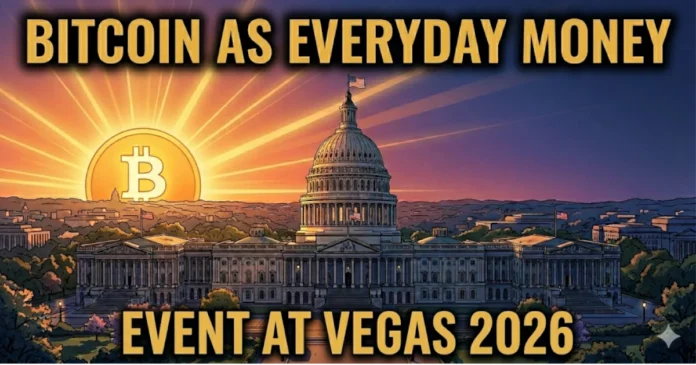
Bitcoin for Financial Services will be organizing “Bitcoin as Everyday Money,” a live event and stream, on Tuesday, April 28, 2026, at 10:00 AM PT within The Venetian’s Satoshi Social Room (Rooms 2002–2004) during Bitcoin 2026 in Las Vegas.
With a capacity of 100 in-person participants and a global stream via TFTC, the gathering aims to unite policy advocates, industry leaders, and business proprietors toward a singular aim: “achieving a Bitcoin de minimis tax exemption this legislative session,” as stated in a press release provided to Bitcoin Magazine.
The event features Janessa Lopez, Head of Digital Assets Policy at Block, and David Zell, President of the Bitcoin Policy Institute, as its main speakers. Lopez and Zell will commence with a candid discussion on the current landscape in Washington, revealing insights gained from private discussions on Capitol Hill and assessing the genuine likelihood of legislation passing in 2026.
Following this, Lopez will conduct a live “BTC is Money” demonstration, illustrating how a small enterprise can accept Bitcoin at the point of purchase through Square, and detailing the customer experience of using Bitcoin for everyday transactions like buying coffee or paying for plumbing services. The program, scheduled from 10:00 AM to 12:00 PM PT, will conclude with an audience Q&A session and a networking reception. Wyatt O’Rourke and Jordan Guess of Bitcoin for Financial Services are hosting the event.
De Minimis Tax Framework at Bitcoin 2026
This event builds upon a coalition letter dated January 12, 2026, addressed to Senate Finance Chairman Mike Crapo and House Ways and Means Chairman Jason Smith. The letter, co-signed by organizations including the Bitcoin Policy Institute, Block, Bitcoin Voter Project, Crypto Council for Innovation, The Digital Chamber, MoonPay, and River, outlines a proposed three-part structure for digital asset tax policy:
- (1) Treating stablecoins that comply with GENIUS as akin to cash, without any limits on transactions or annual usage.
- (2) Extending de minimis relief to “qualifying network digital assets” on blockchains that maintain a trailing six-month average market capitalization exceeding $25 billion. This parameter is intended to include Bitcoin while excluding assets with lower trading volumes or those considered speculative.
- (3) Establishing a value-based limit of $600 per transaction and $20,000 annually, as opposed to a gain-based assessment that would necessitate taxpayers meticulously tracking the cost basis for every minor purchase, such as a cup of coffee.
“This proposed structure directly addresses current legislative proposals in Washington that seek to restrict de minimis relief solely to stablecoins,” the press release indicated. The coalition contends that such a limited approach would leave the fundamental compliance challenges “largely unresolved,” given that every stablecoin transaction still necessitates a taxable Bitcoin or Ethereum fee for on-chain movement.
The discussion has garnered public attention, notably through a March 2026 exchange between Jack Dorsey, CEO of Block, and Brian Armstrong, CEO of Coinbase, concerning whether Bitcoin was being intentionally sidelined in de minimis exemption discussions. Dorsey has clearly articulated his perspective on the stakes involved, stating on the Presidio Bitcoin podcast last year, “I believe it must be for payments to remain relevant in daily life… if it does not evolve into a payment method and find that everyday use case, it will become increasingly irrelevant. In my view, that constitutes failure.”
“We observe this situation frequently with our clients; they would be eager to utilize their Bitcoin to foster a circular Bitcoin economy, but the existing tax reporting regulations impose an excessive burden on the general public, compelling them to continue using dollars,” commented Jordan Guess, co-founder of Bitcoin for Financial Services. He further added, “We advocate for a free market to determine the preferred currency for spending, without governmental favoritability towards any single currency through the imposition of self-tracking and reporting burdens on transactions within a decentralized Bitcoin ledger.”
The event is produced collaboratively with Block, the Bitcoin Policy Institute, and BTC Inc., with support from sponsors including Satoshi Pacioli Accounting, Bitcoin Well, and Falcon Rappaport & Berkman. TFTC will broadcast the entire program live on its YouTube channel at youtube.com/@TFTC. Participants will depart with a clear course of action, including a standardized message for contacting their elected officials and a link to btcismoney.xyz, serving as the central resource for the broader initiative.
Sign-ups for in-person attendance are now open at luma.com/sy4ghp9o. Remote viewers can join the stream via TFTC on YouTube starting at 10:00 AM PT on April 28. With the 2026 legislative calendar progressing and Congress shifting focus towards the midterm elections, the coalition’s message carries urgency: “the pathway for Bitcoin to function as everyday currency in the United States is paved by de minimis tax reform, and this reform must be enacted by the current Congress.”
Details can be found on the website : bitcoinmagazine.com