

 Prefer us on Google
  Download App
  Download App
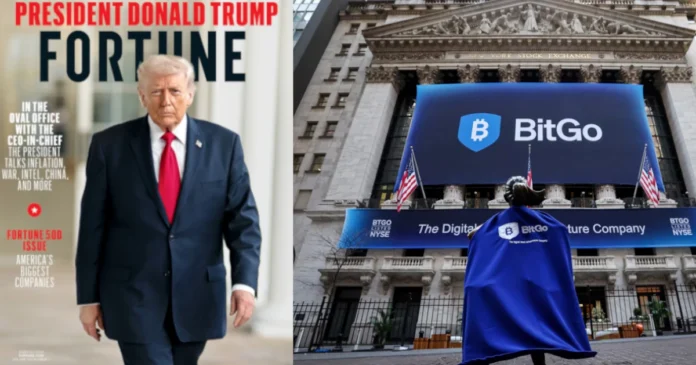
BitGo Holdings, Inc. (NYSE: BTGO) has achieved a significant distinction by being named to the 2026 Fortune 500 list, becoming the inaugural true digital asset infrastructure company to attain this recognition. This debut appearance occurs merely five months after the company’s initial public offering on the New York Stock Exchange in January 2026, reporting an approximate revenue of $16.2 billion for the fiscal year 2025.
The 2026 edition of the Fortune 500, gracing its cover with President Donald Trump and now available for purchase, positions BitGo at the 273rd spot. Further highlighting BitGo’s prominence, the company is also featured in related media coverage, and CEO Mike Belshe is set for a notable feature in the forthcoming Fortune Crypto 100 compilation in August, complete with editorial coverage and special cover editions.
While numerous mining operations, major trading platforms, and treasury-focused entities have entered the public markets in recent times, BitGo distinguishes itself as the pioneering dedicated infrastructure provider—focusing on custody, digital wallets, transaction settlement, and associated services—to reach Fortune 500 status so swiftly post-listing.
Historical Context and Development
BitGo was established in 2011 by Mike Belshe, who continues to lead as its CEO, alongside co-founders Bill Lee, Ben Davenport, and Will O’Brien. Its inception was rooted in offering secure Bitcoin wallets and robust institutional-grade custody solutions, prioritizing multi-signature technology and enterprise-level security at a time when secure options for substantial digital asset holdings were scarce.
Throughout its more than a decade of operation, the company has evolved into a preeminent entity in digital asset infrastructure, supporting the wallet, custody, trading, and operational needs for a multitude of prominent platforms, investment funds, and established institutions within the Bitcoin and wider cryptocurrency ecosystem.
Present Operations and Regulatory Status
Currently, BitGo functions as a comprehensive infrastructure provider. It operates under the name BitGo Bank & Trust, National Association, a federally chartered national trust bank supervised by the Office of the Comptroller of the Currency (OCC). This banking charter, secured in December 2025, mandates rigorous federal compliance—including elevated capital requirements, periodic independent audits, thorough risk management protocols, and fiduciary responsibilities—while concurrently conferring substantial strategic advantages.
The OCC charter ensures consistent federal oversight and legal clarity, superseding the complexities of state-specific licensing in numerous instances and providing institutional clients with the assurance expected from a federally regulated fiduciary. It facilitates nationwide service capabilities by allowing federal preemption over certain redundant state-level regulations.
Nick Payton, VP of Marketing at BitGo, informed Bitcoin Magazine that the OCC federal charter, coupled with its status as a publicly traded company, resolves the regulatory uncertainties that institutional clients often seek. Payton elaborated that the company invested resources to alleviate this burden for its clientele. He further characterized the OCC federal charter as a significant competitive advantage that software alone, even enhanced by artificial intelligence, cannot easily replicate.
Furthermore, the OCC federal charter has fortified BitGo’s capacity to broaden its service offerings, including stablecoin infrastructure, yield generation from cold custody holdings, Prime trading services, derivatives, and tokenization initiatives, all under a clear federal regulatory framework. This strategic positioning solidifies BitGo’s role as a crucial conduit between traditional financial systems and digital assets.
Its clientele predominantly consists of institutional players, such as exchanges, investment funds, and issuers of Bitcoin Exchange-Traded Funds (ETFs). Notable clients include 21Shares (providing custody for Bitcoin ETFs), Fold (which leverages BitGo’s infrastructure for its core functionalities), World Liberty Financial (handling custody and infrastructure for its USD1 stablecoin), and SoFi (offering infrastructure and distribution support for SoFiUSD, recognized as the inaugural U.S. national bank-issued stablecoin on a public blockchain).
High-net-worth individuals also utilize the platform for qualified custody services, cold storage-based staking, and Prime brokerage solutions. While the broader platform encompasses some retail-oriented tools, BitGo has deliberately maintained its focus on institutional and sophisticated clients, eschewing the development of a mass-market retail platform.
Prime Brokerage Services and Global Reach
BitGo has expanded its Prime brokerage operations to incorporate over-the-counter (OTC) trading, electronic trading, and derivatives, services that have recently become operational. These offerings empower clients to access market liquidity, execute intricate trading strategies, and manage collateral directly from their qualified custody accounts. The services cater to operational requirements such as securing loans against Bitcoin assets or generating yield without the need to withdraw assets from the platform.
The company maintains a global presence, serving clients in over 100 countries. It holds regulated licenses and operates entities in key international jurisdictions, including a VARA license in Dubai, a London office, a Latin American hub in Mexico City, and an Asia-Pacific base in Singapore, according to Payton.
Sources of Revenue
Payton further detailed the company’s principal revenue streams, which are predominantly derived from custody fees—the company’s foundational service—alongside other burgeoning revenue channels such as BitGo Prime, encompassing its OTC, electronic trading, and newly launched derivatives services.
The staking of digital assets also ranks among the company’s significant revenue generators, enabling clients to earn returns on assets like Ethereum and Solana while maintaining them in secure cold storage. Additionally, stablecoins have emerged as a rapidly growing segment of the company’s revenue through its Stablecoin-as-a-Service platform, which manages the minting, burning, and custody of these assets. Recent examples include support for World Liberty Financial’s USD1, which Payton noted as one of the fastest-expanding stablecoins, nearing substantial circulation, and SoFi’s SoFiUSD, which commenced with an initial mint of $150 million and has plans for further expansion.
Payton also disclosed that “Bitcoin has consistently driven substantial volume at BitGo. However, Ethereum, Solana, and stablecoins are also significant contributors.” He added: “A key detail we have not publicly disclosed is that we are among the top ten largest entities holding Bitcoin globally, with over 470,000 BTC under our custody,” positioning BitGo as one of the world’s foremost Bitcoin custodians. For its own corporate treasury, BitGo Holdings manages approximately 2,449 BTC, according to the latest public disclosures, making BitGo the holder of the 32nd largest corporate treasury reserves globally.
Future Prospects in Tokenization
Regarding current strategic priorities, Payton conveyed considerable enthusiasm for “tokenization,” a widely discussed yet somewhat nebulous concept within the industry. He defines it as the digital representation of conventional assets—particularly public and private equities—on blockchain-based infrastructure.
“We are optimistic about the future of tokenization. We believe it will democratize access to public markets for a broader spectrum of individuals. We are also exploring the tokenization of private company assets, specifically traditional equity, not solely public securities,” Payton stated. He cautioned, however, that “This must be executed with prudence and security. We aim to prevent the formation of a speculative bubble; it requires a responsible approach.”
Details can be found on the website : bitcoinmagazine.com