

A significant dispute has emerged over a Polymarket prediction market valued at over $120 million, concerning a potential U.S.-Iran peace deal. The market’s resolution criteria hinge on the definition of a “permanent peace deal” agreed upon by June 15, with participants divided on whether a recently announced memorandum of understanding meets these specific terms. The market’s rules require an explicit indication of the permanent cessation of military hostilities between the two nations.
The ongoing debate has led to the market entering Polymarket’s dispute resolution process, which involves holders of UMA’s governance token casting votes on the contested outcome. Current voting trends show overwhelming support, with over 99% of voting power favoring a “Yes” resolution, indicating that the agreement is considered to meet the market’s stipulations. This market represents one of the largest political prediction markets currently active on the Polymarket platform.
Key Takeaways
- A $120 million Polymarket market focused on a U.S.-Iran “permanent peace deal” is under dispute regarding its resolution criteria.
- A memorandum of understanding announced on June 15 is the subject of contention, with differing interpretations of whether it constitutes a permanent cessation of hostilities.
- UMA token holders are voting on the market’s outcome, with preliminary results heavily favoring a “Yes” resolution.
- This dispute follows a similar controversy involving a Polymarket contract related to Strategy’s bitcoin sales earlier this month.
- The complexity arises from differing interpretations of official statements and the agreement’s terms, including a 60-day ceasefire.
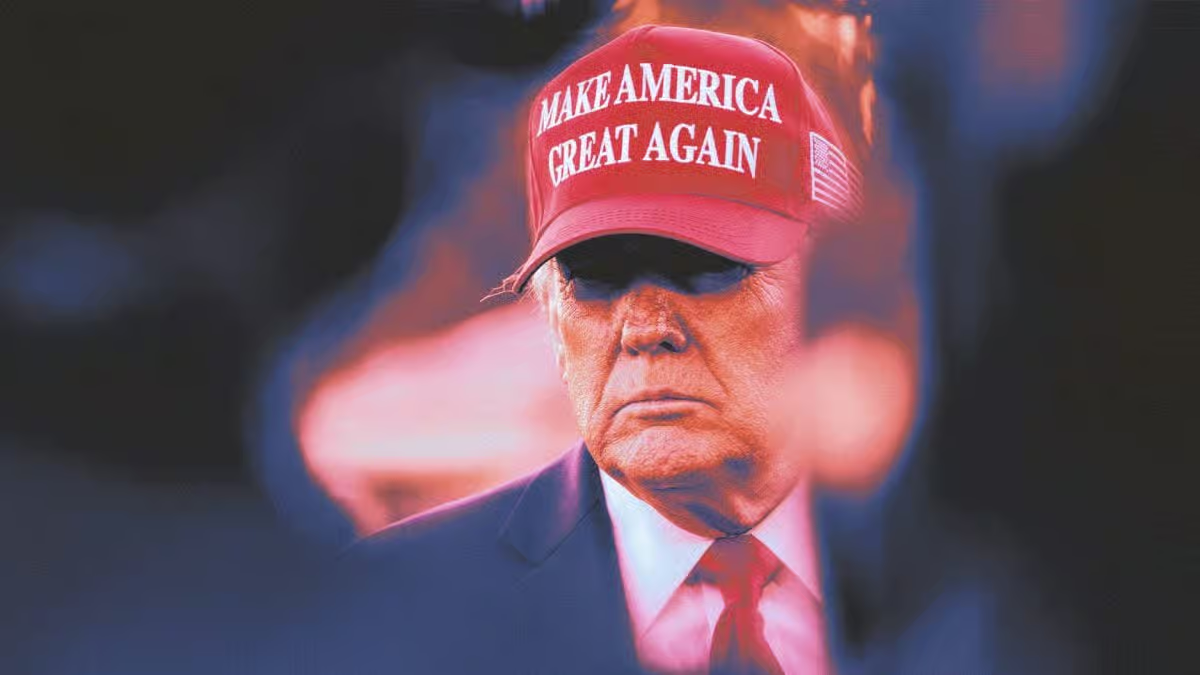
The crux of the dispute lies in the interpretation of a memorandum of understanding (MOU) finalized on June 15. The Trump administration has presented this MOU as a resolution to the conflict. Prior to this, former President Trump had indicated on social media that a deal was imminent and subsequently complete. Iran’s Supreme National Security Council also confirmed the finalization of the MOU following protracted negotiations.
Proponents of a “Yes” outcome point to these official statements as definitive proof that both governments acknowledged a deal had been struck before the market’s deadline. However, participants who acquired “No” contracts argue that the MOU does not align with the market’s strict definition of a permanent peace agreement. Their contention is supported by the fact that the agreement includes a 60-day ceasefire, and critical issues such as Iran’s nuclear program and international sanctions remain subjects for future negotiations.
“It’s a memorandum of understanding,” Trump told reporters on the sidelines of the G7 summit in France, according to Reuters. “If I don’t like it, we’ll go back to shooting at them, dropping bombs on their head.”
Adding further complexity, former President Trump made remarks on June 19, after the market deadline had passed, describing the agreement as an interim measure rather than a final settlement. These comments, made at the G7 summit, suggest a more fluid and less permanent arrangement than the market’s resolution criteria might imply.
Regulatory Precedent and Legal Implications
While Polymarket operates as a decentralized platform and its markets are based on user-generated outcomes, disputes like this highlight the evolving legal landscape for prediction markets and decentralized applications (dApps). The core legal issue centers on contract enforceability and the interpretation of terms within a decentralized framework. Unlike traditional financial markets, where regulatory bodies like the SEC provide oversight, dApps often operate in a more autonomous space, relying on community governance for dispute resolution.
The legal stakes for Polymarket and its users involve the potential for regulatory scrutiny, particularly concerning whether these markets could be classified as unregistered securities or gambling operations, depending on the jurisdiction. The SEC has previously signaled concerns about decentralized finance (DeFi) platforms and the potential for illicit activities. The clarity and fairness of dispute resolution mechanisms, such as the UMA voting process, become paramount in establishing legitimacy and mitigating legal risks. The precedent set by how such high-value, contentious markets are resolved can influence future regulatory approaches to prediction markets and other dApps that facilitate complex financial agreements based on real-world events.
Polymarket Disputes and Compliance Challenges
This U.S.-Iran peace deal market controversy is not an isolated incident for Polymarket. The platform recently experienced a similar dispute concerning a market that predicted whether Strategy would sell any bitcoin before May 31. In that instance, an UMA vote ultimately resolved the contract to “No,” despite objections from some traders who claimed a sale had occurred before the deadline, even if it was only disclosed in an SEC filing afterward.
These repeated disputes underscore the inherent challenges in establishing clear, objective, and universally accepted resolution criteria for prediction markets tied to complex real-world events. For platforms like Polymarket, maintaining user trust and navigating potential regulatory frameworks requires robust and transparent dispute resolution processes. The legal and compliance implications are significant, as the industry continues to mature and attract greater attention from regulators globally, who are keenly observing how these decentralized systems handle financial agreements and potential disputes.
Original article : www.theblock.co