


 Prefer us on Google
  Download App
  Download App
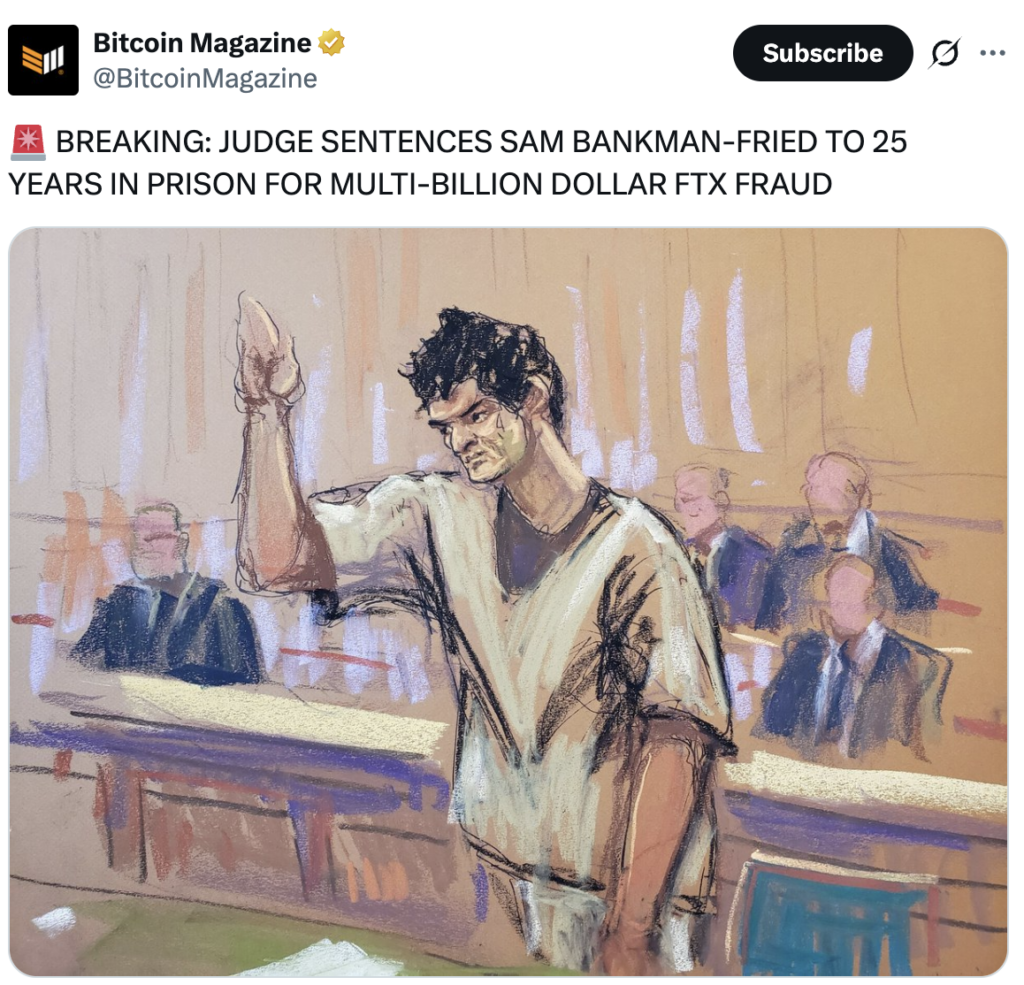
One of Sam Bankman-Fried’s final viable avenues to freedom diminished on Friday as a federal appellate court affirmed his conviction for fraud and his 25-year prison sentence, declaring the evidence against him, in the court’s own phrasing, “robust, to put it mildly.”
A panel of three judges from the 2nd U.S. Circuit Court of Appeals in Manhattan delivered the 42-page decision on June 12, rejecting all arguments presented by Sam Bankman-Fried’s defense team aimed at nullifying the November 2023 conviction, which marked one of the most significant financial implosions in cryptocurrency history, as reported by Reuters.
Central to the appeal was the assertion that U.S. District Judge Lewis Kaplan had prejudiced Sam Bankman-Fried’s defense by excluding evidence suggesting FTX possessed sufficient assets to meet customer withdrawal demands.
Alexandra Shapiro, a defense attorney, argued before the appellate panel in November 2025 that “Mr. Bankman-Fried’s trial was fundamentally unfair because the jury only got to hear one side of the story.”
Prosecutors contended that Kaplan’s ruling was justified, stating that fraud allegations are predicated on misuse of funds, not on hypothetical scenarios where liabilities could have been covered under different conditions. The appellate panel concurred, finding the trial court’s evidentiary rulings sound and the prosecution’s case against Sam Bankman-Fried to be overwhelmingly strong.
The Downfall of FTX
The exchange, once valued at $32 billion, imploded in November 2022 when it was revealed that Alameda Research, Bankman-Fried’s associated hedge fund, relied on FTX’s own exchange token rather than independent assets for its balance sheet. This revelation sparked a wave of customer withdrawals, exposing an $8 billion deficit in FTX’s accounts.
Three of Bankman-Fried’s former associates—Alameda CEO Caroline Ellison, FTX co-founder Gary Wang, and head of engineering Nishad Singh—pleaded guilty and testified against him. Ellison, the key witness, informed the jury that Bankman-Fried had instructed her to reroute customer deposits to Alameda to settle debts with crypto lenders. She testified, “Sam directed me to commit these crimes.”
Following Bankman-Fried’s sentencing in March 2024, the court mandated an $11 billion forfeiture and three years of supervised release. Ellison received a two-year sentence and was released in January 2026, having served 14 months.
The appellate court’s decision comes just weeks after Bankman-Fried submitted a formal clemency request to the DOJ’s Office of the Pardon Attorney, seeking a presidential pardon from Donald Trump. The application is noted as a “pardon after completion of sentence,” not a commutation, and Trump has publicly stated he will not grant it.
In April 2026, Judge Kaplan dismissed a separate motion for a new trial under Rule 33, characterizing Bankman-Fried’s assertion that witnesses had faced government threats as “wildly conspiratorial and entirely contradicted by the record.” Bankman-Fried had previously withdrawn an earlier version of this motion on April 22 without prejudice.
With the 2nd Circuit’s decision, his remaining legal avenues are limited to a habeas corpus petition—a path with a lower success rate than direct appeals—or a petition to the Supreme Court.
The Future for Sam Bankman-Fried
Sam Bankman-Fried is currently housed in a minimum-security federal correctional institution near Santa Barbara, California, and is not scheduled for release until 2044.
In a recent prison interview with Fox Business, he reiterated his stance: “I didn’t steal user funds.” He cited the recovery of crypto assets by the FTX bankruptcy estate, which has enabled the estate to repay creditors more than 100% of their claims—a point he frames as evidence of FTX’s underlying financial stability, although courts at all levels have dismissed this interpretation.
Friday’s ruling concludes the legal proceedings for what federal prosecutors described as a “fraud of epic proportions”—a case that eroded institutional trust in crypto markets, prompted congressional inquiries, and compelled exchanges throughout the industry to revise their proof-of-reserves methodologies.
In January, President Donald Trump declared he would not pardon former FTX CEO Sam Bankman-Fried, denying clemency to the convicted cryptocurrency executive.
Source: : bitcoinmagazine.com