

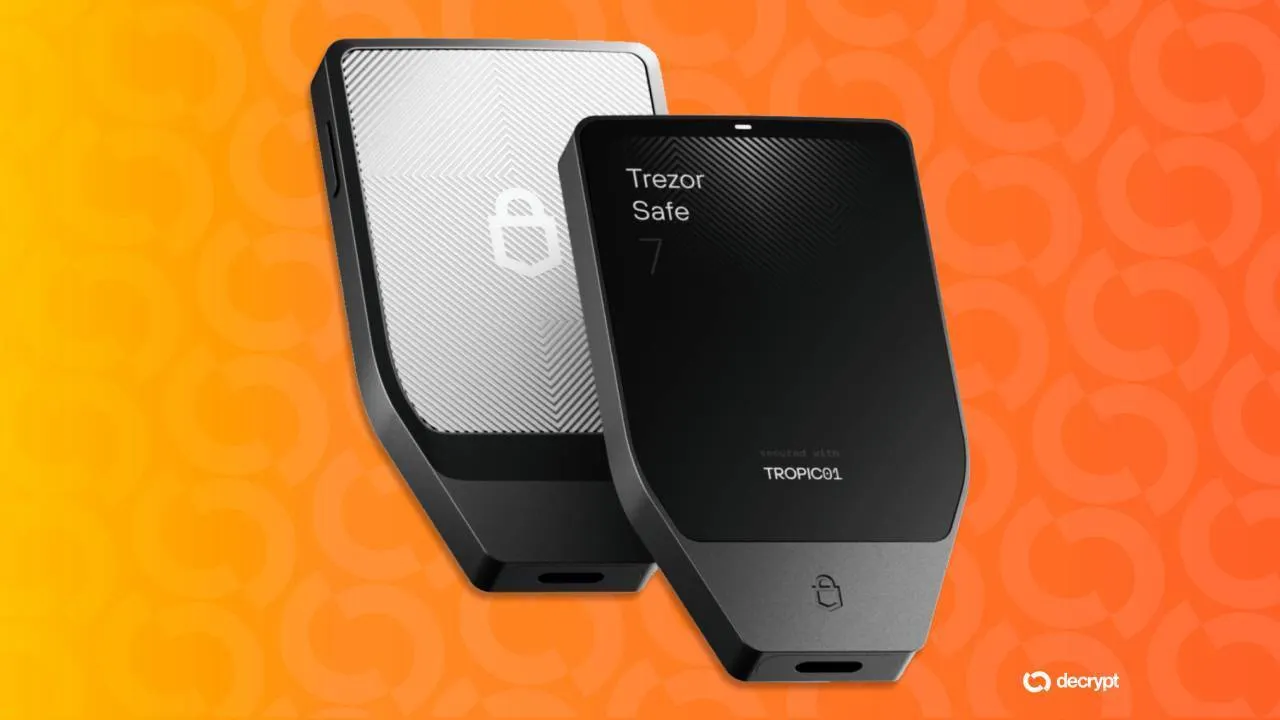
Trezor Addresses Hardware Vulnerability in Safe 7 Wallet
Trezor has disclosed a security vulnerability affecting the TROPIC01 Secure Element chip within its flagship Safe 7 hardware wallet. This discovery, made during an independent audit by the Ledger Donjon team, involves a sophisticated “laser fault injection attack.” While the exploit can reduce the wallet’s multi-layered PIN protection from three “secrets” to two, Trezor emphasizes that user funds remain secure due to the inherent difficulty and specific requirements for executing the attack.
Key Takeaways
- A hardware vulnerability was identified in Trezor’s TROPIC01 Secure Element chip by the Ledger Donjon audit team.
- The exploit allows for the extraction of one of three “secrets” protecting the user’s PIN, reducing security layers from three to two.
- Successful execution requires physical access to the wallet, disassembly, and specialized laboratory equipment, making it highly impractical for most attackers.
- User private keys are not stored on the vulnerable TROPIC01 chip, and the PIN remains the final layer of protection for funds.
- Due to the hardware-based nature of the vulnerability, a firmware update cannot patch the issue.
The security audit revealed that a laser fault injection attack could compromise the TROPIC01 chip. This chip is one of three physical, independent security layers within the Trezor Safe 7. Trezor has clarified that compromising this chip alone is insufficient to bypass the PIN, which serves as the ultimate safeguard for a user’s assets. Furthermore, the exploit cannot lead to the installation of persistent malicious firmware on the device.
Tropic Square disclosed a vulnerability in the TROPIC01 Secure Element chip used in Trezor Safe 7. It has been identified based on findings from the Ledger Donjon team’s independent audit.
Important: Your funds remain safe and secure. Trezor Safe 7 has not been hacked, and you…
— Trezor (@Trezor) June 3, 2026
Trezor asserts that the complexity of the attack, which mandates physical possession, disassembly of the wallet, and the use of specialized lab equipment, presents a significant barrier. The company maintains that the TROPIC01 chip still functions as an “effective barrier” requiring substantial time and resources to exploit, thus assuring users that their funds are protected.
Blockchain security firm Cyvers corroborated Trezor’s assessment, characterizing the attack as “highly impractical.” Hardware wallets, often referred to as “cold” wallets, secure private keys offline on physical devices, distinguishing them from “hot” wallets like MetaMask that rely on software or cloud storage. In the case of the Trezor Safe 7, the private keys are not stored on the TROPIC01 chip, adding another layer of defense.
Given the hardware-centric nature of the vulnerability, it cannot be rectified through a software update. Trezor has not yet commented on potential refund policies for affected customers. Security experts suggest that for the average user, the more significant threats continue to be phishing attempts, seed phrase theft, interactions with malicious decentralized applications (dApps), and inadvertently signing unverified transactions.
Long-Term Technological Implications for Blockchain Security
The recent discovery of a hardware vulnerability in a secure element chip used in a leading hardware wallet underscores a critical frontier in blockchain security: the physical security of digital assets. While software exploits and smart contract vulnerabilities have long dominated security concerns, this incident highlights the increasing sophistication of physical attack vectors against hardware designed to protect private keys. This development will likely spur greater investment and innovation in secure element design and testing protocols within the cryptocurrency space. Expect a stronger emphasis on advanced cryptographic techniques and potentially new architectural approaches that further compartmentalize critical security functions, making them even more resilient to sophisticated physical tampering. This could also accelerate the integration of AI-driven anomaly detection within hardware security modules, proactively identifying and mitigating potential fault injection attempts in real-time. For Layer 2 solutions and Web3 development, reinforcing the trust and security of underlying hardware infrastructure is paramount. A robust and demonstrably secure hardware base provides a more solid foundation for scaling blockchain networks and developing complex decentralized applications, ultimately boosting user confidence and adoption.
Original article : decrypt.co