

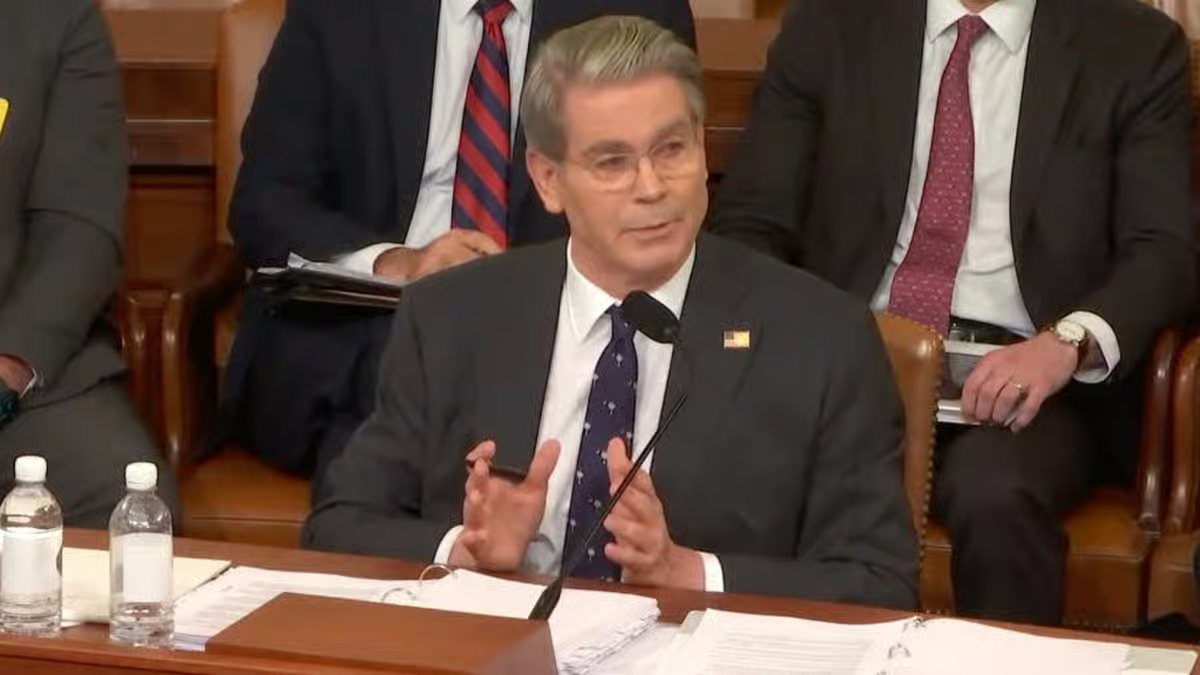
U.S. Treasury Secretary Scott Bessent has unequivocally stated that the current administration will not pursue a central bank digital currency (CBDC). This position signals a definitive stance against a digital form of currency directly issued and governed by the nation’s central bank.
Key Takeaways
- The U.S. administration has confirmed it will not implement a central bank digital currency (CBDC).
- Treasury Secretary Scott Bessent views CBDCs as a potential tool for surveillance and thus are “off the table.”
- The administration aims to position the U.S. as a leading jurisdiction for digital asset innovation and regulation.
- Emphasis is placed on bringing digital asset activities “onshore” to establish a regulated environment.
- Legislative progress is being urged for the Clarity Act to formalize rules within the digital asset sector.
During a White House press briefing, Bessent articulated that CBDCs are definitively “off the table,” emphasizing the administration’s commitment to fostering the U.S. as a hub for digital assets. He expressed concerns that a CBDC could be a precursor to enhanced government tracking of financial transactions.
“This administration has been very clear, there will be no central bank digital currency, which I think would be the first step toward tracking, so we have taken that off the table,” Bessent stated. “The most important thing we could do is to make digital assets come into the United States.”
Bessent also highlighted legislative momentum for the Clarity Act, a bill designed to establish a regulatory framework for the digital asset industry. He characterized the current offshore digital asset landscape as unregulated, or the “wild, wild west,” underscoring the need to bring such activities under U.S. jurisdiction for proper oversight.
“When you look at digital assets, all the nonsense that happens, all the things you read about, that’s because it’s the wild, wild west offshore, so we have to bring it onshore,” the Treasury Secretary remarked. “So I would encourage the House and the Senate to get Clarity done.”
This stance aligns with previous statements made by Bessent during his nomination hearing in January 2025, where he indicated that a U.S. CBDC was unnecessary and primarily relevant for nations lacking alternative investment avenues. A significant number of Republican lawmakers have also voiced opposition, citing concerns over potential government overreach and surveillance of individuals’ financial activities.
Meanwhile, the Clarity Act, which seeks to define rules for the digital asset sector, recently advanced through the Senate Banking Committee. However, its path forward has been complicated by debates surrounding stablecoin remuneration and ethical considerations within the bill, particularly concerning potential conflicts of interest for the U.S. President. Analysts suggest that further amendments, specifically regarding conflict of interest standards, may be necessary to secure sufficient bipartisan support for its passage.
President Trump has also publicly reaffirmed his objective to lead global digital asset regulation. He recently stated his administration’s intent to establish a “future-proof” digital asset market structure, designed to be resilient against opposition from those he termed “crypto haters.”
Potential Regulatory Precedent
The definitive rejection of a U.S. CBDC by the current administration, coupled with an expressed desire to proactively regulate digital assets domestically, could set a significant regulatory precedent. By prioritizing the creation of a clear onshore framework through legislation like the Clarity Act, the U.S. signals an intention to shape the global digital asset landscape through established regulatory mechanisms rather than through the adoption of a state-controlled digital currency. This approach could encourage other jurisdictions to focus on developing similar legislative frameworks for digital assets, potentially leading to a more fragmented global regulatory environment where national laws dictate the terms of digital asset engagement, rather than a unified global standard potentially influenced by CBDC implementations. The emphasis on bringing digital asset activities onshore also suggests a regulatory strategy centered on traditional financial oversight principles, applied to new technological paradigms.
Details can be found on the website : www.theblock.co