


For decades, the fundamental trade-off in battery technology has been capacity versus charging time: the more energy a battery stores, the longer it takes to charge. This principle, deeply ingrained in our understanding of electrochemical energy storage, is now being challenged by a groundbreaking development from Australian researchers. A team from CSIRO, Australia’s national science agency, in collaboration with RMIT University and the University of Melbourne, has successfully demonstrated the world’s first working prototype of a quantum battery.
Key Takeaways
- Australian scientists have developed the first functional prototype of a quantum battery.
- Unlike conventional batteries, quantum batteries exhibit faster charging times as their size increases, a phenomenon dubbed “superabsorption.”
- The prototype charges wirelessly via a laser pulse in femtoseconds and stores energy for nanoseconds.
- While not yet suitable for consumer electronics or electric vehicles, this technology holds significant promise for powering future quantum computers.
- The quantum battery operates at room temperature, offering a practical advantage over cryogenic approaches.
This novel device operates not on chemistry, but on the principles of quantum physics. The prototype, a layered wafer of organic materials, is charged wirelessly by an extremely brief laser pulse lasting mere femtoseconds—a quadrillionth of a second. Following this rapid charge, the battery can store energy for nanoseconds, a duration significantly longer than its charging time, by several orders of magnitude.
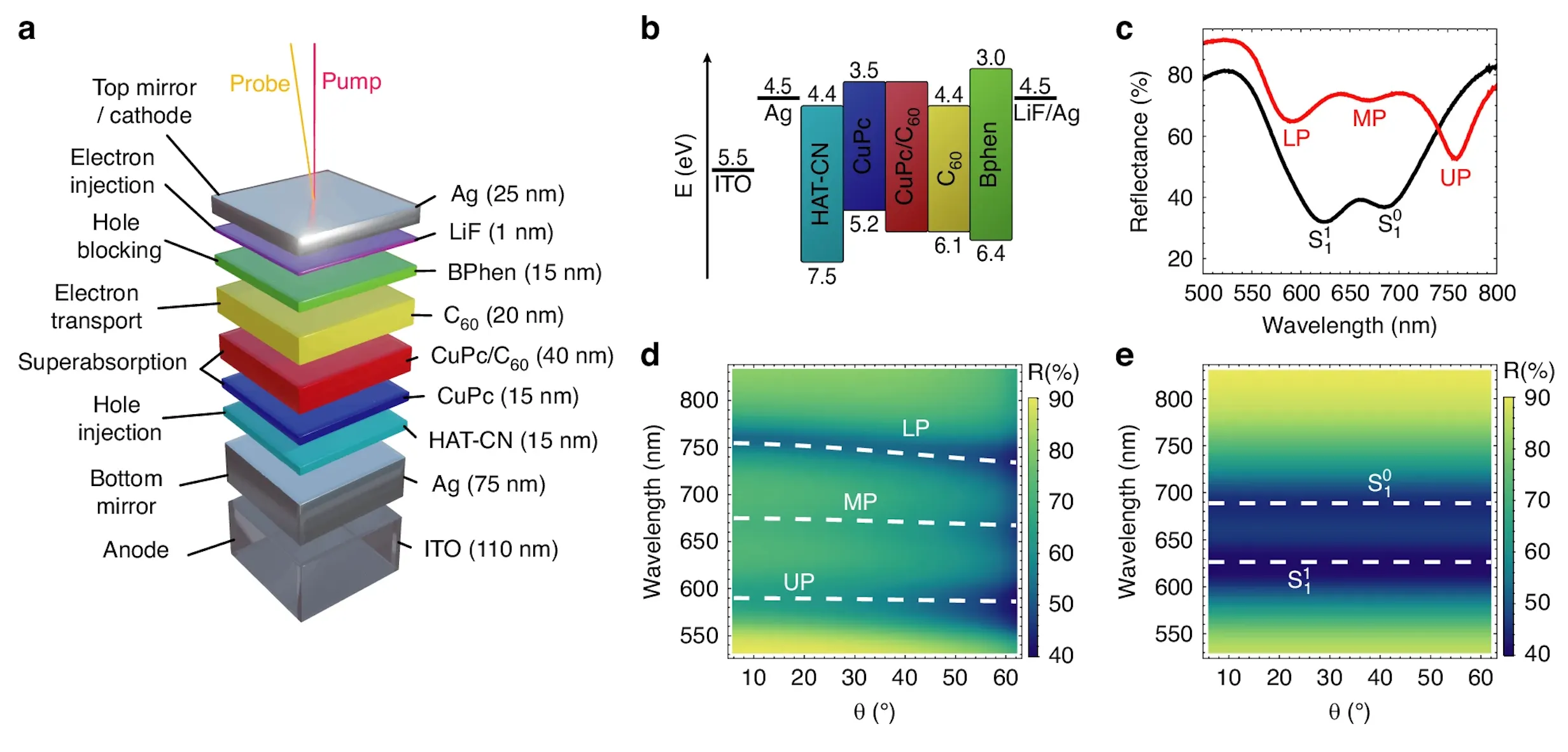
The most revolutionary aspect of this quantum battery is its scaling behavior. Conventional batteries require exponentially more time to charge as their capacity grows. In stark contrast, the quantum battery’s charging time decreases with size. This counterintuitive property, known as “superabsorption,” occurs because the molecules within the battery do not act independently but collectively, sharing the incoming energy in a synchronized burst. Researchers have mathematically described this as the charging time dropping proportionally to 1/√N, where N represents the number of molecules. Effectively, doubling the battery’s size could reduce its charging time by almost half.
This theoretical prediction, first posited in 2013 and partially demonstrated in 2022, has now been realized with the addition of a crucial component: the ability to extract the stored energy as an electrical current. Previous quantum battery experiments had not achieved this complete charge-discharge cycle. Furthermore, the Australian prototype operates at room temperature, distinguishing it from other quantum energy storage concepts that necessitate extreme cold.
While the current energy capacity of the prototype is minuscule—measured in billionths of electron-volts—making it unsuitable for immediate application in consumer devices or electric vehicles, its implications for quantum computing are profound. Quantum computers, with their advanced computational capabilities, require highly stable and noise-free energy sources. Quantum batteries, by operating and discharging using quantum principles, can provide this energy coherently, minimizing interference and aligning with the operational language of quantum processors.
Professor Andrew White, a leader in quantum technology at the University of Queensland, noted that quantum batteries could offer “energy coherently, with the minimum energy cost to the quantum computers.” CSIRO is actively seeking partnerships with deep-tech investors and industries, including electric vehicle manufacturers, to accelerate the development and scaling of this transformative technology, bridging the gap between theoretical possibility and practical application.
Long-Term Technological Impact
The advent of practical quantum batteries represents a significant leap forward, potentially reshaping the landscape of high-performance computing and energy storage. For quantum computing, this innovation could be a foundational enabler, providing the clean, coherent power necessary for these complex machines to operate reliably and efficiently. As quantum computers grow in power and sophistication, the demand for specialized energy solutions will intensify, making room-temperature quantum batteries a critical component for their advancement. Beyond quantum computing, the fundamental principle of superabsorption, where energy input scales inversely with system size, could inspire entirely new paradigms in energy transfer and storage across various technological domains. While widespread consumer adoption remains a distant prospect, the successful demonstration of a working quantum battery prototype marks a pivotal moment, indicating that the quantum realm is increasingly capable of providing tangible solutions to some of our most pressing technological challenges.
Details can be found on the website : decrypt.co